hard water hammam generator UAE
UAESTEAMSAUNA

Hard Water Hammam Generator UAE: Why It Fails & How to Stop It

October 23, 2026
By : uaesaunasteam
0 Comments

Hard Water Hammam Generator UAE: Why It Fails and How to Stop It

Your UAE hammam steam generator is quietly being destroyed — one heating cycle at a time. Dubai and Abu Dhabi municipal water carries 350–450 PPM of dissolved minerals, and every litre boiled inside your generator deposits another thin layer of calcium carbonate scale on the heating element. This guide explains how hard water hammam generator damage in UAE works, what it costs when you ignore it, and the exact prevention programme that extends generator life from 18 months to 5–8 years.

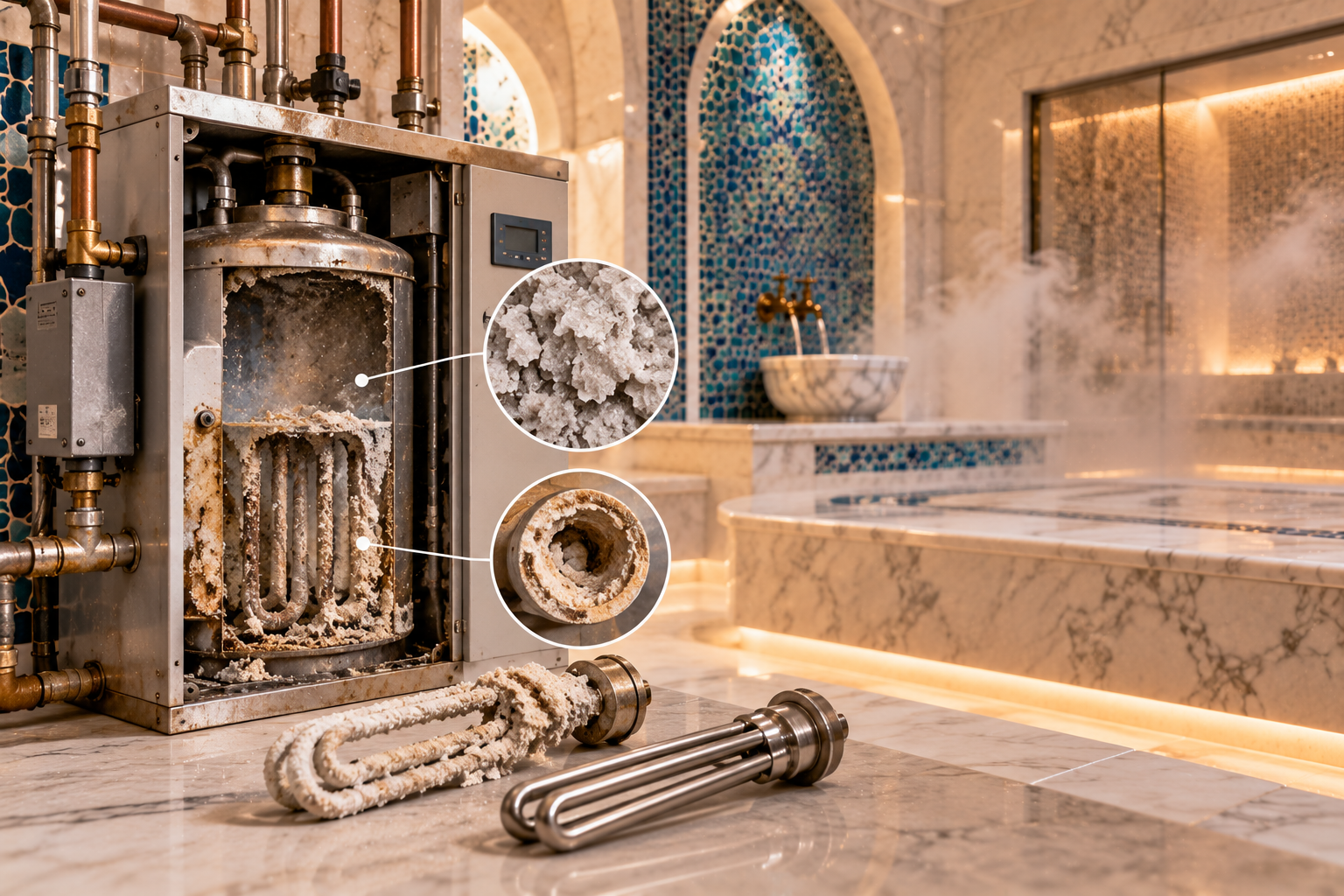
Hard water hammam generator UAE damage is caused by limescale accumulation on the heating element. UAE municipal water averages 400+ PPM total dissolved solids (TDS) — two to four times harder than European supplies. When this mineral-rich water is heated, calcium carbonate crystallises out and bonds to the heating element surface. At 6 mm of scale, efficiency drops by over 30%. At 12–15 mm — reached within 12–18 months without treatment — the element burns out. Emergency replacement costs AED 18,000–45,000. A prevention programme combining a water softener (AED 8,000–15,000), monthly descaling (AED 2,000–4,000/year) and regular anode checks costs less than AED 40,000 over five years and keeps generators running for 5–8 years.

UAE Water Hardness: Why Hard Water Hammam Generator Damage Is Inevitable Without Treatment

Water hardness measures dissolved calcium and magnesium ions — minerals that enter water as it passes through limestone formations. The UAE draws municipal water from two sources: underground aquifers (already high in dissolved minerals) and desalinated seawater, which is remineralised after treatment to meet drinking water standards and protect distribution infrastructure from corrosion. Both sources deliver hard water to building inlets.

400+
PPM average TDS in Dubai municipal water — among the highest of any major global city
300–450
PPM TDS range across UAE emirates — Abu Dhabi, Sharjah and beyond are similarly hard
100–150
PPM TDS in typical London or Berlin municipal water — 2–4× softer than UAE supply
3–5×
Faster scale build-up rate in UAE hammam steam generators versus European installations

When hard water is heated inside a hammam steam generator, dissolved calcium bicarbonate converts to calcium carbonate (limescale) as CO₂ is driven off. The calcium carbonate cannot stay dissolved at high temperature — it precipitates and bonds permanently to the heating element. This chemistry happens anywhere in the world; in the UAE, it happens 3–5 times faster than in Europe. Every manufacturer descaling schedule — typically quarterly — was written for moderate-hardness water. In the UAE, those intervals must be monthly.

🔬

There Is No Soft Source of UAE Municipal Water at the Tap

Even water that begins as desalinated seawater arrives at a UAE building inlet already remineralised to hardness levels comparable to aquifer-sourced water. The remineralisation step is mandatory to prevent pipe corrosion in the distribution network. There is no municipal supply zone in the UAE that delivers soft water to buildings. The only way to reduce mineral content reaching a hammam steam generator is active pre-treatment — a water softener, RO unit or chemical dosing system — installed on the generator’s dedicated supply line.

How Hard Water Destroys a Hammam Steam Generator: The Scale Process Step by Step

Understanding scale formation helps operators see why prevention — not reactive repairs — is the only financially viable strategy for hard water hammam generator management in UAE.

1️⃣
Hard water enters the generator tank. Municipal water at 350–450 PPM TDS fills the tank via the water inlet solenoid. The minerals are dissolved — invisible and harmless at this stage.
2️⃣
The heating element raises water to boiling. As temperature approaches 100°C, dissolved calcium bicarbonate undergoes an irreversible chemical change: Ca(HCO₃)₂ → CaCO₃ + H₂O + CO₂. CO₂ escapes as gas; calcium carbonate cannot stay dissolved and precipitates out of solution.
3️⃣
CaCO₃ crystals bond to the element surface. Precipitated calcium carbonate is attracted to the hottest surface in the system — the heating element. Crystals bond to the element and to each other, forming an initial hard layer. This layer is invisible after one heating cycle but begins accumulating immediately.
4️⃣
Each heating cycle adds another layer. In Dubai’s 400+ PPM TDS water, a typical commercial hammam generator accumulates approximately 0.5–1 mm of scale per month on the element surface under daily operation without water treatment.
5️⃣
Scale acts as thermal insulation — forcing the element to work harder. Calcium carbonate is approximately 40 times less thermally conductive than heating element steel. As scale thickens, the element must reach progressively higher temperatures to transfer the same heat to the water — driving up energy consumption and causing the element to operate above its design specification.
6️⃣
The overheating element fails. At 12–15 mm scale — reached in 12–18 months in an unprotected UAE generator — the element’s protective sheath overheats and cracks or burns through. The generator trips electrically, loses steam output, or fails entirely. Replacement cost: AED 18,000–45,000.
Damage Timeline

Four Stages of Hard Water Hammam Generator Damage in UAE — With Timelines

Month 1–3 · UAE Timeline Without Treatment

Stage 1: Thin Scale — No Visible Impact

Scale at 1–3 mm has no measurable effect on performance. The generator runs normally and steam output is at rated capacity. This is the optimal descaling window — thin scale dissolves quickly with a citric acid flush. Operators who descale monthly at this stage keep generators running indefinitely.

Month 3–6 · UAE Timeline Without Treatment

Stage 2: Moderate Scale — Efficiency Loss Begins

At 3–6 mm, pre-heat time increases noticeably. Energy consumption rises 15–25%. Steam output is slightly reduced. The element is running warmer than its design specification. Professional descaling at this stage restores full performance but requires a longer soak and stronger solution than Stage 1.

Month 6–12 · UAE Timeline Without Treatment

Stage 3: Heavy Scale — Significant Degradation

At 6–12 mm, pre-heat time may have doubled. Energy consumption is 30–50% above baseline. Guests notice reduced steam and longer room warm-up times. The element is under severe thermal stress. Specialist intervention required — scale may be too hard for a standard acid flush and mechanical removal may be needed. Some element damage may already be irreversible.

Month 12–18 · UAE Timeline Without Treatment

Stage 4: Scale-Induced Failure — Generator Replacement

At 12–15 mm, element failure is imminent or has occurred. The generator trips electrically, produces no steam, or fails erratically. In some cases the tank is perforated by corrosion that developed under the scale layer. Emergency element or full generator replacement required: AED 18,000–45,000. This is the outcome for the majority of UAE hammam generators operated without a water treatment and descaling programme.

Seven Warning Signs Your UAE Hammam Generator Is Being Damaged by Hard Water Scale

⏱️

Track Pre-Heat Time Weekly — It Is Your Most Reliable Scale Indicator

Log the generator’s cold-start-to-operating-pressure time when it is new or freshly descaled. A 20% or greater increase from this baseline reliably indicates significant scale accumulation — typically 4–6 mm — and means a descale is overdue. This requires nothing but a phone timer and a maintenance log. It is the earliest and most accessible early warning signal available to any UAE hammam operator or hotel spa manager.

⏱️
Extended pre-heat time. Generator takes noticeably longer than baseline to reach operating steam pressure. A 20% increase typically indicates 4–6 mm of scale — the ideal descaling window.
🌫️
Reduced or inconsistent steam output. The hammam room takes longer to reach target temperature or temperature fluctuates during a session. Scale on the element directly reduces heating rate and steam production capacity.
⚡
Rising energy consumption. If hammam circuit energy draw has increased noticeably from baseline, scale-induced thermal inefficiency is the most likely cause in UAE’s hard-water environment.
🔊
Rumbling, banging or popping sounds during heating (“kettling”). Steam bubbles form under scale deposits before they can escape freely — the same noise a heavily scaled kettle makes. A clear sign of heavy scale accumulation requiring immediate descaling.
🔴
Pressure relief valve activating more frequently. Scale partially blocking the steam outlet pipe increases back-pressure. A PRV that trips more often than it previously did is a scale indicator requiring immediate inspection.
⚠️
Thermal cutout trips or generator error codes. Many commercial generators include a thermal cutout that trips if the element exceeds its maximum operating temperature. Repeated thermal cutout trips in a UAE generator are a late-stage scale warning requiring urgent professional attention.
💧
White deposits on the steam outlet nozzle or generator casing. Visible white or cream chalky residue around the steam nozzle or on the tank exterior confirms that the same scale deposition process is occurring internally on the element at greater scale.

How to Descale a UAE Hammam Steam Generator — Frequency, Method and Products

⚠️

UAE Descaling Frequency Must Be Monthly — Not the Manufacturer’s Quarterly Recommendation

Manufacturer descaling schedules (typically every 3–6 months) are written for 100–200 PPM TDS water — typical of European and North American supplies. In Dubai and Abu Dhabi at 350–450 PPM TDS, scale accumulates 2–4 times faster. Following the manufacturer’s quarterly interval in UAE produces the same result as skipping descaling entirely in a European installation. Any hammam generator in UAE must be descaled monthly — or every 3 weeks for very high-usage commercial operations — to stay ahead of scale accumulation.

1️⃣

Isolate and cool the generator completely. Switch off and electrically isolate the generator. Close the water inlet isolation valve. Allow a minimum of 2 hours from last operation before opening. Never descale a hot generator.

2️⃣

Drain and assess. Open the drain valve and fully drain the tank. Inspect drain water turbidity: clear = minimal current scale; milky or white particles = scale requiring treatment. Log the observation.

3️⃣

Prepare citric acid descaling solution. For regular monthly descaling: citric acid solution at 10–15% concentration. It is effective on calcium carbonate, safe for generator metals, and widely available from UAE spa equipment suppliers. Do not use hydrochloric (muriatic) acid — too aggressive for generator metals and voids most manufacturer warranties.

4️⃣

Fill and soak. Monthly descale (thin scale, with water treatment): 2–4 hours soak. Quarterly descale (without treatment, moderate scale): 6–8 hours, preferably overnight. Heavy scale: specialist intervention required before chemical descaling is effective.

5️⃣

Drain, flush and double-rinse. Drain the descaling solution. Fill and drain with clean water twice to remove all acid residue. Residual descaling agent in the tank damages the element and produces tainted steam reaching the hammam room.

6️⃣

Refill, test and log. Refill with clean water, restore electrical supply, run a test cycle, and log the descale date, condition found and products used. This log tracks whether your current interval is adequate for your supply.
The Overlooked Component

The Sacrificial Anode: Why UAE Hard Water Depletes It Twice as Fast

Most commercial hammam steam generators include a sacrificial anode — a rod of magnesium or aluminium alloy mounted inside the tank. It corrodes preferentially to protect the steel tank walls from electrolytic corrosion in the high-mineral water environment. When the anode is depleted, the tank wall becomes the sacrificial component and begins corroding.

🔩

UAE Anodes Need Replacing Every 3–6 Months — Not Annually

The electrochemical reaction consuming a sacrificial anode is driven by the mineral ion concentration in the surrounding water. In UAE’s high-TDS water, electrochemical activity inside a generator tank is significantly elevated versus soft-water environments. Anodes that last a year in European installations typically require replacement every 3–6 months in UAE. Check the anode at every monthly descale — if remaining metal is below 50% of original diameter, replace it immediately. A depleted anode left in place leads to tank perforation within 6–12 months, requiring complete generator replacement at AED 18,000–45,000.

Beyond the Generator

Hard Water Damage to Other UAE Hammam Components — Complete Reference

ComponentHard Water ImpactUAE TimelinePrevention / Treatment
Steam delivery pipeInternal scale narrows bore; reduced flow; blockage20–30% bore reduction within 12 months without treatmentWater pre-treatment; annual pipe descale or replacement
Steam outlet nozzleScale occludes nozzle; uneven or blocked steam distributionVisible build-up within days in UAE without treatmentWeekly citric acid descale — a standard daily UAE hammam task
Thermostatic mixing valveScale causes calibration drift and temperature creepMore frequent recalibration than European installationsMonthly TMV temperature check; annual service or replacement
Kurna basin and outletsWhite scale on visible surfaces; internal scale in pipe elbowsDaily visible scale build-up in UAEDaily pH-neutral cleaning on stone; weekly acid descale on fittings
Marble and stone surfacesHard water deposits etch polished marble; white mineral stainingSurface etching visible within weeks on unprotected polished marbleRegular pH-neutral cleaning; frequent re-sealing; avoid acid on stone
Drain linesCalcite deposition in pipe walls reduces bore over timeMeasurable bore reduction within 2–3 yearsAnnual CCTV survey; periodic hydro-jetting

Leave a Reply

Your email address will not be published. Required fields are marked *