

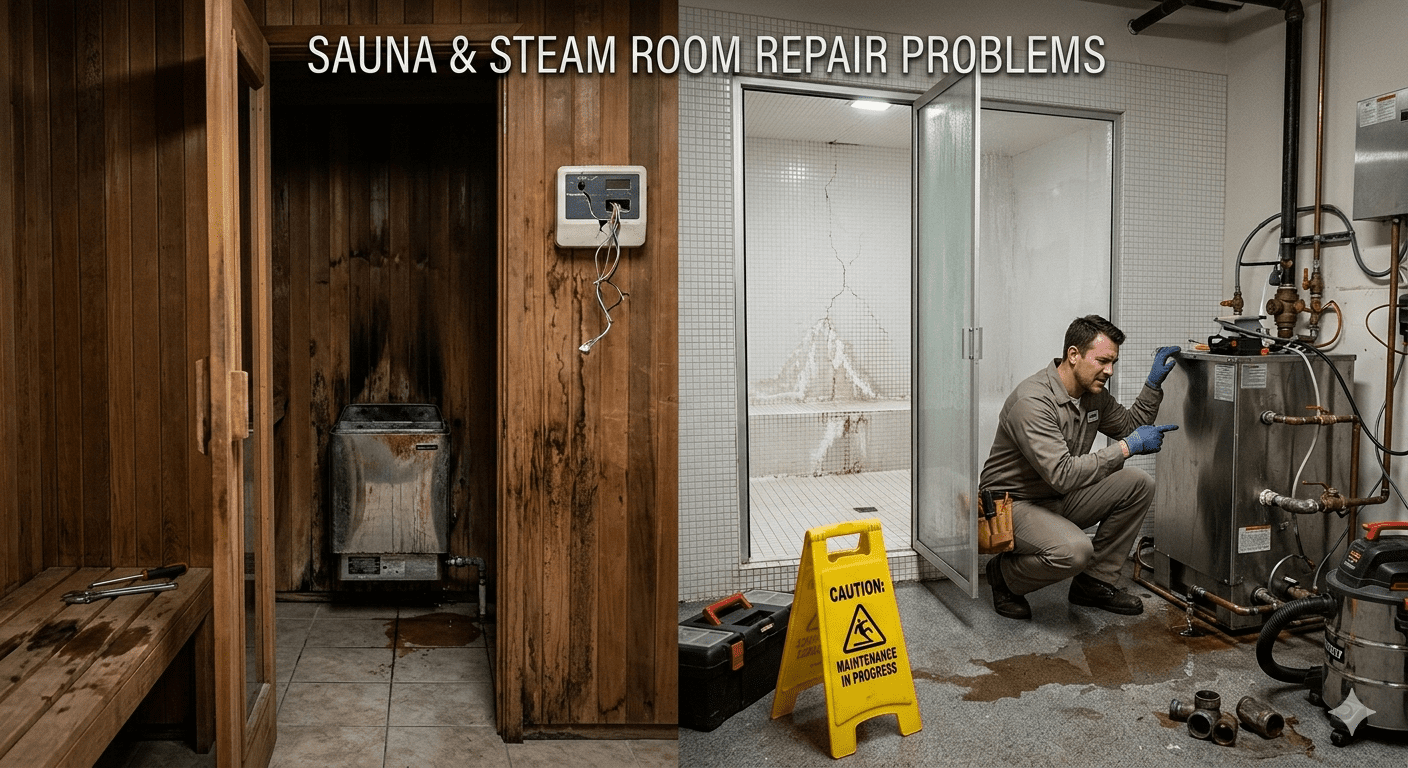
10 Most Searched Sauna & Steam Room Repair Problems
From steam generators that won’t produce steam to mold outbreaks, heater failures, and digital control malfunctions — this guide covers every major repair problem with expert diagnosis, step-by-step fixes, and real cost data.
- Steam Generator Not Producing Steam
- Water Leaks & Water Damage
- Mold & Mildew Growth
- Mineral Scale Buildup
- Temperature Fluctuations
- Sauna Heater Not Working
- Control Panel / Display Failure
- Door Not Sealing Properly
- Strange Noises from Generator
- Sauna Wood Rot & Damage
If your sauna won’t heat up, your steam room is producing no steam, or you’ve spotted mold creeping across the cedar panels— you’re not alone. These are the exact problems thousands of homeowners, spa managers, and HORECA facility teams search for every month.
This guide covers the 10 most searched sauna and steam room repair problems of 2026. For each one, you’ll find the exact cause, a clear fix, realistic repair costs, and guidance on whether it’s a safe DIY job or requires a certified technician.
1.Steam Generator Not Producing Steam
WHAT IS HAPPENING
The single most searched sauna and steam room repair problem globally. You turn the system on, the control panel responds — but after 5–10 minutes there’s no steam. The room stays cool and dry.
MOST COMMON CAUSES
- Mineral scale buildup inside the generator tank blocking the heating element
- Clogged steam head or nozzle outlet from mineral deposits or debris
- Faulty or burnt-out heating element inside the generator
- Solenoid valve failure — the valve that releases water into the boiler is stuck closed
- Low water pressure or closed water inlet valve (minimum 20 PSI required)
- Temperature probe error — displayed as Err or Prr on Mr. Steam, Steamist, Amerec units
- Control board malfunction — unit powers on but heating command is not executing
STEP-BY-STEP FIX
- Check the control panel for error codes — Err1, E05, Prr1/Prr2 indicate specific faults. Consult your brand manual (Mr. Steam, Steamist, Amerec, Kohler) for the code meaning.
- Confirm the water supply valve is fully open and pressure is adequate.
- Inspect the steam head nozzle for mineral blockage. Remove and soak in white vinegar for 30 minutes, then rinse and reinstall.
- Descale the generator: drain the unit, fill with a 50/50 white vinegar and water solution, soak 30–60 minutes, drain and flush with clean water twice.
- If descaling doesn’t resolve it, test the heating element with a multimeter (expect 10–50 ohms; open circuit = element failure — replace).
- If the solenoid valve is faulty (pump runs but no water enters tank), a certified technician should replace it.
Never open the steam generator casing with power connected. Always disconnect at the circuit breaker first. Steam generators operate at 240V and contain live high-voltage components that can cause serious injury or death.
2.Steam Room & Sauna Water Leaks
WHAT IS HAPPENING
Water pooling outside the steam room, damp external walls, or the steam head dripping between sessions — all signs of a leaking enclosure requiring immediate attention to prevent structural and electrical damage.
MOST COMMON CAUSES
- Failed or deteriorated door gasket/seal — the most common cause by far
- Cracked or unsealed tile grout allowing moisture migration through walls or floor
- Steam head dripping between sessions (faulty solenoid valve not fully closing)
- Temperature/pressure relief valve on generator weeping or discharging
- Condensation on poorly insulated walls migrating to exterior surfaces
- Drainage pipe blockage causing water backup and overflow
HOW TO FIX IT
- Inspect the door seal completely — run a finger around the full gasket perimeter. Any crack or hardening means replacement ($30–$80 part, 30-minute DIY job).
- Check all tile grout for cracks. Regrout damaged areas with waterproof epoxy grout and reseal with a penetrating silicone sealer.
- If the steam head drips when the system is off, the solenoid valve needs replacement by a licensed plumber or sauna technician.
- Inspect the T&P relief valve. A weeping valve often indicates excessive scale pressure — descale first, then replace if it continues.
Re-seal all steam room tile grout and wall-to-floor corners every 2 years. Use 100% silicone caulk (not grout) at all corner joints — silicone flexes with temperature changes while grout cracks. This single step prevents the majority of steam room water damage cases.
3.Mold & Mildew Growth in Sauna or Steam Room
WHAT IS HAPPENING
Black, green, or white fuzzy growth on sauna benches, cedar walls, grout lines, or the steam room ceiling — one of the most health-critical repair issues. Mold thrives in the warm, humid environment of a poorly ventilated sauna or steam room.
MOST COMMON CAUSES
- Inadequate ventilation — moisture not exhausted efficiently after sessions
- Door closed immediately after use, trapping humidity inside
- Drainage blockage causing standing water inside the enclosure
- Infrequent cleaning allowing body oils and sweat to feed mold colonies
- Damaged wood or cracked grout providing sheltered mold growth surfaces
STEP-BY-STEP FIX
- For surface mold on cedar:Sand affected panels with 150–220 grit sandpaper, wipe with a 50/50 diluted white vinegar solution, allow to dry completely. Never use bleach on wood — it damages cedar fibres.
- For tile and grout:Scrub with a grout brush using a commercial mold remover rated for steam environments. Re-seal grout once clean and dry.
- Clear the drainage system:Pour boiling water down the drain to break up organic buildup, follow with a drain enzyme cleaner.
- Fix ventilation:Ensure the exhaust vent is unobstructed and the fan is operational. Upgrade if the room takes more than 30 minutes to dry after a session.
- After every use:Leave the door open for at least 30 minutes. Wipe benches with a dry towel. Run ventilation for 15–20 minutes post-session.
Hotels, spas, and gyms should schedule professional sanitization every 3–6 months using EPA-approved hospital-grade solutions that kill 99.99% of bacteria, mold, mildew, and odor-causing fungi — protecting both your facility and guests.
4.Mineral Scale Buildup in Steam Generator
WHAT IS HAPPENING
Limescale is the number one cause of premature steam generator failure. In hard water areas — UAE, Qatar, Florida, most of the UK — calcium and magnesium deposits accumulate inside the boiler tank, coating the heating element and reducing steam output over time.
WARNING SIGNS
- Steam output weaker than usual or slow to build
- Visible white or yellowish crust around the steam head outlet
- Generator making popping, crackling, or rumbling noises during operation
- Generator running longer than normal to produce steam
- Water drainage appears cloudy or contains white particles
HOW TO DESCALE YOUR STEAM GENERATOR
- Power down the generator and allow to cool completely (minimum 1 hour).
- Shut off the water supply valve feeding the generator.
- Drain the existing water from the tank via the drain valve.
- Fill the tank with a 50/50 mixture of food-grade white vinegar and water.
- Allow to soak for 30–60 minutes (up to 2 hours for heavy buildup).
- Drain the vinegar solution and flush with clean cold water at least twice until the water runs clear.
- Restore power and run a brief steam test cycle to confirm improved output.
SOFT WATER:Every 6–12 months | MODERATELY HARD:Every 3–6 months | HARD WATER (UAE, QATAR, FLORIDA, UK):Every 1–3 months | VERY HARD WATER:Monthly. Installing a water softener upstream of the generator reduces scale maintenance by up to 80%.
5.Temperature Fluctuations — Too Hot, Too Cold, or Inconsistent
WHAT IS HAPPENING
The room reaches temperature then drops unexpectedly. The heater runs continuously without shutting off. Or you set 85°C and get 60°C. Temperature instability is frustrating and can indicate a safety risk if the unit cannot self-regulate properly.
MOST COMMON CAUSES
- Faulty or miscalibrated thermostat — the most common cause
- Temperature sensor (probe) failure or incorrect positioning
- Poor door or wall insulation allowing heat to escape
- Undersized heater for the room volume
- Ventilation system drawing heat out too aggressively
- Heating element partially burnt out — reduced capacity output
THERMOSTAT CALIBRATION — STEP BY STEP
- Access the thermostat control panel. (Mr. Steam, Steamist, Amerec, Kohler each have different calibration procedures — consult your specific manual.)
- Set the target temperature and allow a full 15–20 minute warm-up cycle.
- Use an independent thermometer at bench level (not near the steam outlet) to compare actual temperature vs. thermostat reading.
- If the differential exceeds 5°C, recalibrate per manufacturer instructions or replace the sensor probe.
- For Prr1/Prr2 error codes on Mr. Steam units: these indicate the temperature probe cable is damaged or the room has exceeded safe thresholds. Reset per manual instructions.
6.Sauna Heater Not Working — No Heat
WHAT IS HAPPENING
The control panel lights up or responds, but the heater produces no heat — or insufficient heat. One of the most frequently searched sauna problems, especially for electric sauna heaters (the most common residential type).
MOST COMMON CAUSES
- Tripped circuit breaker— always check this first; it is the most common cause
- Faulty heating element — elements burn out over time, particularly in hard water areas
- Damaged or coated stones inside the heater reducing heat conductivity
- Broken thermostat preventing the heater from engaging
- Loose or corroded wiring connections at the heater or control box
- Timer or control unit malfunction blocking the heating command
DIY VS PROFESSIONAL — WHAT YOU CAN CHECK
Stones should be replaced every 1–2 YEARSin residential use and every 6–12 MONTHSin commercial use. Cracked, dusty, or heavily coated stones significantly reduce heater efficiency and can damage the element. Replacement cost: $40–$120.
7.Control Panel / Digital Display Failure
WHAT IS HAPPENING
The control panel is blank, frozen, showing error codes, or responding erratically. Modern sauna and steam room systems depend entirely on digital controls — when these fail, the entire system becomes inoperable even if the mechanical parts are fine.
COMMON ERROR CODES DECODED
- Err1 (Mr. Steam):Incorrect field supply voltage — voltage too low. Generator shuts down completely. Call a licensed electrician.
- Prr1 (Mr. Steam):Temperature probe error — cable cut, damaged, or shorted. Replace control cable PN 104117-30.
- Prr2 (Mr. Steam):Room temperature exceeded 137°F (58.3°C). Allow room to cool, then manually reset using ON/OFF button.
- E05 (Amerec):Water supply issue — system not receiving enough water. Check supply valve and inlet strainer.
- E11 (Amerec):Temperature sensor malfunction or improper connection. Inspect sensor wiring and positioning.
TROUBLESHOOTING STEPS
- Hard reset:Turn off power at the circuit breaker for 60 seconds, then restore. Clears temporary control board faults in most cases.
- Check the control cable connectionbetween panel and generator. A loose or pinched cable (especially Mr. Steam’s MSTS cable) is a very common fault that mimics total control failure.
- If Err1 appears, contact a licensed electrician to verify supply voltage meets specifications.
- If display remains blank with power confirmed, the control panel unit likely requires replacement. Contact your brand’s support line: Mr. Steam 800-767-8326 | Steamist via steamist.com | Amerec via amerec.com.
8.Sauna Door Not Sealing Properly
WHAT IS HAPPENING
The sauna door doesn’t close tightly, heat escapes through the gap, the room takes too long to reach temperature, or steam escapes around the door frame during sessions. A failed door seal is one of the most common and most fixable sauna problems.
CAUSES & TARGETED FIXES
- Worn door gasket:Replace the rubber or silicone gasket seal — $30–$80 for the part. Most are adhesive-backed and replaceable in under 30 minutes with no special tools.
- Door frame warping:Wood expands and contracts with heat cycles. Sand the frame at the point of resistance, then treat with a high-temperature sauna-rated wood oil.
- Hinge misalignment:Loosen hinge screws, realign the door to sit flush, re-tighten. Use longer screws if the mounting wood has softened.
- Glass door crack or chip:A cracked tempered glass sauna door must be replaced entirely — do not attempt to seal a crack. Cost: $250–$500.
- Bottom threshold seal failure:Replace the bottom sweep with a high-temperature silicone sweep ($20–$50).
Close the sauna door on a piece of paper. If you can pull the paper out without resistance anywhere around the perimeter, the seal is failing and heat is escaping. A proper seal should grip the paper firmly at every point around the door.
9.Strange Noises from the Steam Generator or Heater
NOISE DIAGNOSIS TABLE
| Sound Type | Most Likely Cause | Fix |
|---|---|---|
| Popping / Crackling | Mineral scale on heating element expanding under heat | Descale the generator (see Problem #4) |
| Rumbling / Gurgling | Air trapped in water lines or low water flow | Bleed the water lines; check supply pressure |
| High-pitched hissing | Steam escaping from a loose fitting or cracked steam line | Inspect all steam pipe connections; tighten or replace fittings |
| Banging / Knocking | Water hammer in supply lines | Install a water hammer arrestor upstream of the generator |
| Constant humming | Pump running without water — dry run condition | Check water supply immediately; prolonged dry running damages pump |
| Clicking without heat | Relay or contactor switching but element not engaging | Test element with multimeter; replace if open circuit |
A pump running dry without water is an emergency condition. Prolonged dry running can destroy the pump in minutes and void your warranty. Shut the system off and check the water supply before restarting.
10.Sauna Wood Rot, Discolouration & Structural Damage
WHAT IS HAPPENING
Sauna benches turning dark grey or black, cedar panels becoming soft to the touch, visible splits or warping in the wood, or a persistent musty odour even after cleaning — all signs of wood degradation that must be addressed immediately.
TYPES OF DAMAGE & SPECIFIC REPAIRS
- Surface discolouration (grey/black staining):Sand affected surfaces with 120–150 grit sandpaper using a dustless orbital sander, working in the direction of the grain. Wipe clean and apply a sauna-rated wood protector. Never use varnish, lacquer, or standard wood stains inside a sauna — at high temperatures these emit toxic fumes.
- Soft or spongy wood (early rot):Treat with a borate-based anti-rot solution that penetrates wood fibres and halts fungal decay. Replace individual planks if more than 20% of the cross-section is compromised.
- Splitting or cracking:Normal for kiln-dried wood under repeated heat cycles. Sand edges smooth and treat with food-safe sauna wood oil. Severe splits require full plank replacement.
- Full bench or panel replacement:Use kiln-dried Western Red Cedar, Nordic Spruce, or Aspen. Never use pressure-treated or painted wood. Cost: $200–$800 residential bench set; $500–$2,000+ for full wall lining.
ANNUALLY:Sand and oil all exposed surfaces | EVERY 3–6 MONTHS:Deep clean and sanitize | EVERY 6 MONTHS:Inspect benches for structural integrity | EVERY 1–2 YEARS:Replace sauna stones | EVERY 3–5 YEARS:Professional wood restoration for commercial facilities.
Preventive Maintenance Schedule
Most sauna and steam room repairs are entirely preventable. Here is the exact schedule used by top spa and hotel facilities.
| Frequency | Task |
|---|---|
| After Every Use | Wipe benches and walls dry. Leave door open 30+ minutes. Run exhaust fan until room is dry. Rinse steam head with clean water. |
| Weekly | Scrub benches with mild soap or sauna cleaner. Check drain for blockage. Inspect door seal visually. Clean steam head nozzle thoroughly. |
| Monthly | Deep clean all wood surfaces. Test all controls and temperature settings. Inspect tiles and grout for cracks. Check water inlet strainer for scale buildup. |
| Every 1–3 Months | Descale the steam generator with vinegar flush (frequency based on water hardness). Inspect T&P relief valve. Lubricate door hinges with silicone spray. |
| Every 6 Months | Professional sanitization treatment. Inspect heating element resistance with multimeter. Check all electrical connections for corrosion. Inspect wood for soft spots or cracking. |
| Annually | Replace sauna stones. Sand and re-oil all wood surfaces. Full system inspection by certified technician. Test thermostat calibration. Review generator service record and warranty status. |
Frequently Asked Questions
Why is my steam room not producing steam?
The most common causes are mineral scale buildup inside the generator tank, a clogged steam head nozzle, a faulty heating element, or a closed water supply valve. Start by descaling the generator and cleaning the steam head before calling a technician. Check for error codes on your control panel — Err1, E05, and Prr codes all point to specific identifiable faults.
How much does it cost to repair a sauna?
Most sauna repairs cost between $200 and $800, with an average around $500. Simple repairs like stone replacement or door seal replacement cost $30–$120. More complex repairs like heating element or full generator replacement can run $400–$2,500. Always get at least 2 quotes from certified sauna technicians for any repair over $300.
How often should I descale my steam generator?
In hard water areas (UAE, Qatar, Florida, most of the UK), descale every 1–3 months. In soft water areas, every 6–12 months. Key signs you need descaling: reduced or slow steam output, popping or crackling noises during operation, or visible white deposits around the steam head outlet.
Can I repair a steam generator myself?
Cleaning, descaling, and replacing accessible parts like the steam head or door seal are safe DIY tasks. However, any repair involving the internal electrical components of the generator — heating element, solenoid valve, control board — must be performed by a licensed electrician or certified sauna technician. Steam generators operate at 240V and contain components that can cause serious injury or death if mishandled.
What brands do sauna repair technicians service?
Most certified technicians service all major brands including Mr. Steam, Steamist, Amerec, Kohler, Delta, Thermasol, Finnlandia, Tylö, and Harvia. When booking, always confirm the technician has brand-specific experience with your model — error codes and part numbers vary significantly between brands.
How long do steam generators last?
A well-maintained residential steam generator typically lasts 10–15 years. Commercial generators under heavy daily use typically need major service every 5–8 years. Regular descaling and prompt attention to error codes are the most effective ways to maximize generator lifespan.
Why does my sauna smell musty even after cleaning?
A persistent musty odour almost always indicates mold or mildew — typically caused by inadequate post-session ventilation or leaving the door closed after use. Deep clean and sand the wood surfaces, verify the drainage is clear, and upgrade your exhaust fan if needed. For commercial facilities, book a professional sanitization service using hospital-grade biocidal solutions.
Most Sauna & Steam Room Problems Are Fixable
Whether your steam generator has stopped producing steam, your sauna heater won’t reach temperature, or you have mold spreading across the cedar — every problem covered in this guide has a clear, proven fix. The key is diagnosing correctly before spending money, following the right repair sequence, and knowing when to stop DIY and call a certified technician.
The most impactful thing you can do right now is start a preventive maintenance routine. The majority of expensive repair calls could have been avoided with 15 minutes of monthly maintenance and a $10 bottle of white vinegar.