

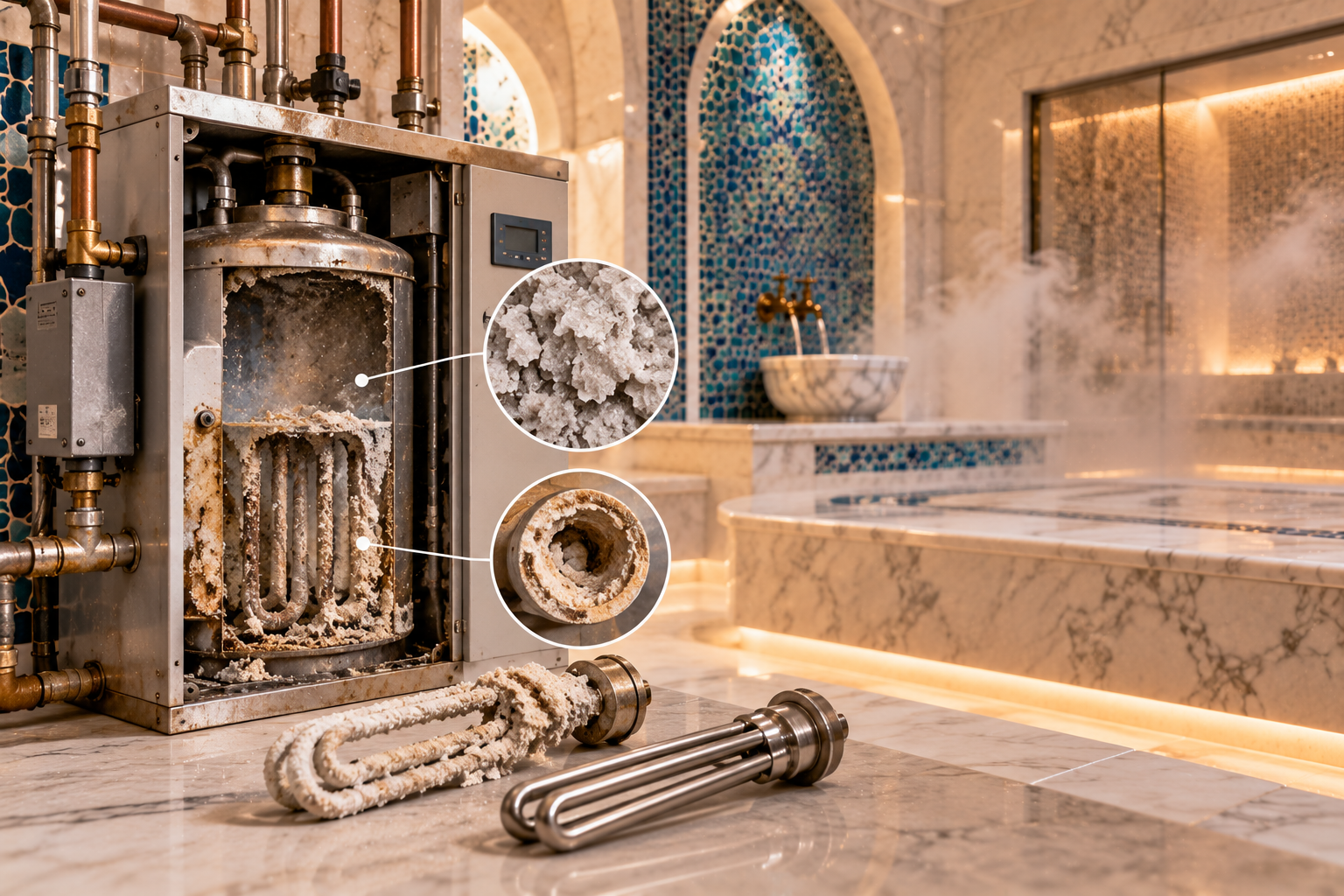
UAE Water Hardness: Why Hard Water Hammam Generator Damage Is Inevitable Without Treatment
Water hardness measures dissolved calcium and magnesium ions — minerals that enter water as it passes through limestone formations. The UAE draws municipal water from two sources: underground aquifers (already high in dissolved minerals) and desalinated seawater, which is remineralised after treatment to meet drinking water standards and protect distribution infrastructure from corrosion. Both sources deliver hard water to building inlets.
When hard water is heated inside a hammam steam generator, dissolved calcium bicarbonate converts to calcium carbonate (limescale) as CO₂ is driven off. The calcium carbonate cannot stay dissolved at high temperature — it precipitates and bonds permanently to the heating element. This chemistry happens anywhere in the world; in the UAE, it happens 3–5 times faster than in Europe. Every manufacturer descaling schedule — typically quarterly — was written for moderate-hardness water. In the UAE, those intervals must be monthly.

There Is No Soft Source of UAE Municipal Water at the Tap
Even water that begins as desalinated seawater arrives at a UAE building inlet already remineralised to hardness levels comparable to aquifer-sourced water. The remineralisation step is mandatory to prevent pipe corrosion in the distribution network. There is no municipal supply zone in the UAE that delivers soft water to buildings. The only way to reduce mineral content reaching a hammam steam generator is active pre-treatment — a water softener, RO unit or chemical dosing system — installed on the generator’s dedicated supply line.
How to Descale a UAE Hammam Steam Generator — Frequency, Method and Products

UAE Descaling Frequency Must Be Monthly — Not the Manufacturer’s Quarterly Recommendation
Manufacturer descaling schedules (typically every 3–6 months) are written for 100–200 PPM TDS water — typical of European and North American supplies. In Dubai and Abu Dhabi at 350–450 PPM TDS, scale accumulates 2–4 times faster. Following the manufacturer’s quarterly interval in UAE produces the same result as skipping descaling entirely in a European installation. Any hammam generator in UAE must be descaled monthly — or every 3 weeks for very high-usage commercial operations — to stay ahead of scale accumulation.


The Sacrificial Anode: Why UAE Hard Water Depletes It Twice as Fast
Most commercial hammam steam generators include a sacrificial anode — a rod of magnesium or aluminium alloy mounted inside the tank. It corrodes preferentially to protect the steel tank walls from electrolytic corrosion in the high-mineral water environment. When the anode is depleted, the tank wall becomes the sacrificial component and begins corroding.

UAE Anodes Need Replacing Every 3–6 Months — Not Annually
The electrochemical reaction consuming a sacrificial anode is driven by the mineral ion concentration in the surrounding water. In UAE’s high-TDS water, electrochemical activity inside a generator tank is significantly elevated versus soft-water environments. Anodes that last a year in European installations typically require replacement every 3–6 months in UAE. Check the anode at every monthly descale — if remaining metal is below 50% of original diameter, replace it immediately. A depleted anode left in place leads to tank perforation within 6–12 months, requiring complete generator replacement at AED 18,000–45,000.
Hard Water Damage to Other UAE Hammam Components — Complete Reference
| Component | Hard Water Impact | UAE Timeline | Prevention / Treatment |
|---|---|---|---|
| Steam delivery pipe | Internal scale narrows bore; reduced flow; blockage | 20–30% bore reduction within 12 months without treatment | Water pre-treatment; annual pipe descale or replacement |
| Steam outlet nozzle | Scale occludes nozzle; uneven or blocked steam distribution | Visible build-up within days in UAE without treatment | Weekly citric acid descale — a standard daily UAE hammam task |
| Thermostatic mixing valve | Scale causes calibration drift and temperature creep | More frequent recalibration than European installations | Monthly TMV temperature check; annual service or replacement |
| Kurna basin and outlets | White scale on visible surfaces; internal scale in pipe elbows | Daily visible scale build-up in UAE | Daily pH-neutral cleaning on stone; weekly acid descale on fittings |
| Marble and stone surfaces | Hard water deposits etch polished marble; white mineral staining | Surface etching visible within weeks on unprotected polished marble | Regular pH-neutral cleaning; frequent re-sealing; avoid acid on stone |
| Drain lines | Calcite deposition in pipe walls reduces bore over time | Measurable bore reduction within 2–3 years | Annual CCTV survey; periodic hydro-jetting |