

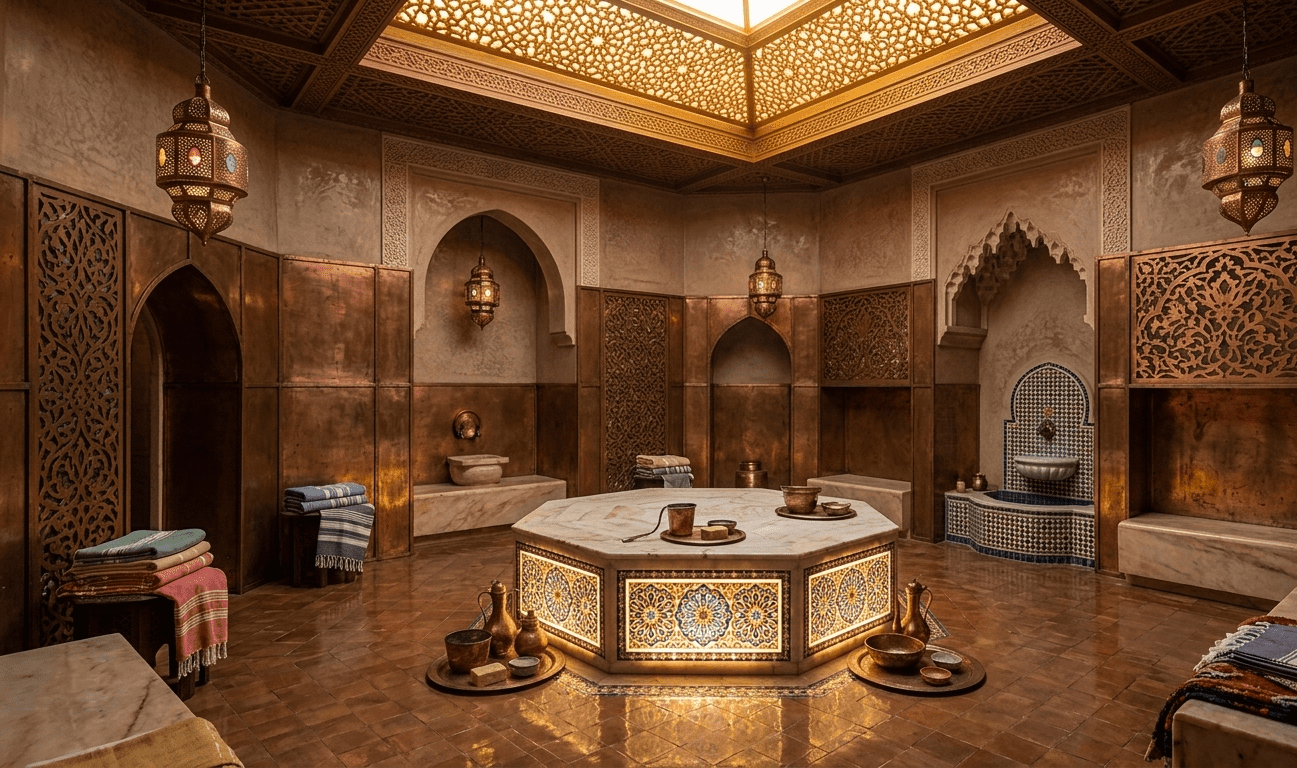
How to Renovate an Existing Hammam in Dubai Without Full Demolition
When a Moroccan hammam in a Dubai villa or hotel starts showing its age — cracked zellige tiles, black grout lines, a tadelakt wall that has lost its lustre, a heating system that takes twice as long to reach temperature as it once did — the default response from many contractors is to strip the entire space back to bare concrete and start again. In most cases, this is neither necessary nor the most cost-effective approach.
A well-planned hammam renovation in Dubai can achieve a result that is visually and functionally indistinguishable from a full rebuild — at a fraction of the cost, in a fraction of the time and with a fraction of the noise and disruption. The key is knowing which elements genuinely need to be replaced, which can be restored, and which can be transformed with surface treatments and system upgrades that require no demolition at all.
This guide gives Dubai hammam owners and property managers the complete non-demolition renovation framework: assessment, decision-making, phase-by-phase execution and realistic costs. For professional hammam renovation and restoration services in Dubai that maximise what can be saved and minimise disruption, our team is available across the Emirates.
Step 1 — Assess Before You Decide Anything
The single most important step in any Dubai hammam renovation project is a thorough pre-work assessment that identifies exactly what is failing and why. Renovating without a proper assessment is the reason many partial renovation projects fail — a cosmetic fix applied over an underlying structural problem creates a result that fails again within 12–18 months and ultimately costs more than the full renovation would have.
The Assessment Checklist — Work Through Every Element:
- use a coin or screwdriver handle to tap every zellige and bejmat tile — a hollow, drum-like sound indicates the tile has separated from its adhesive bed and is at risk of cracking under thermal stress; mark every hollow tileTap test all tiles:
- probe grout lines with a key or grout rake tip — crumbling, soft or hollow grout indicates adhesive failure beneath; discoloured but firm grout can be raked and replaced without tile disturbanceCheck all grout joints:
- any blackening, cracking, lifting or gapping at wall-to-floor and wall-to-wall junctions indicates moisture pathway — these must be replaced regardless of the rest of the renovation scopeInspect all internal corner silicone:
- press gently on any visually stained or cracked areas — soft or hollow tadelakt behind a crack indicates delamination; firm tadelakt with surface cracks or staining can be restored without replasteringCheck tadelakt walls:
- time the heat-up from cold to target temperature; listen for unusual sounds; check steam nozzle output from each nozzle individually; note any safety cutoff trips during a test sessionRun the heating system:
- pour a bucket of water onto the floor and time the clearance — over 45 seconds indicates a partial blockage; check the drain trap for odour and the drain cover for mineral scaleInspect the drain:
- systematic photography of every wall section, floor area and grout line before any work begins creates the baseline for snagging and is essential if you are briefing a renovation contractorPhotograph everything:
PROBLEM FOUND | APPROACH | ACTION REQUIRED |
Hollow tiles (some, under 30%) | Restore | Re-bond with high-temperature PU adhesive through drilled injection or by tile lift and re-bonding |
Hollow tiles (over 40% of area) | Replace | Section lift and re-installation with correct C2TE adhesive — do not attempt spot-bonding at this level |
Cracked / chipped zellige (individual) | Replace | Source matching tile; lift individually; re-bond; regrout — does not disturb surrounding tiles |
Firm grout — surface stained/mouldy | Restore | Rake to 4mm depth; replace with flexible anti-mould C2 grout — no tile disturbance |
Crumbling or hollow grout | Replace | Full rake-out; check adhesive condition below; regrout with C2 or epoxy grout |
Corner silicone — any blackening | Replace | Full removal; clean; replace with anti-mould silicone — non-negotiable regardless of other scope |
Tadelakt — surface cracks, firm behind | Restore | Fill with matching lime paste; polish; savon beldi treatment — no replastering required |
Tadelakt — soft or hollow behind cracks | Replace | Affected section must be removed and re-applied by a tadelakt specialist |
Steam generator — slow heat-up | Restore | Professional descale + thermostat calibration restores output in most cases |
Steam generator — element failure | Replace | Element replacement by specialist — full generator replacement only if casing or control board also damaged |
Blocked drain | Restore | Enzyme drain treatment + physical clearing; replace trap seal if odour persists after clearing |
The 5-Phase Dubai Hammam Renovation Sequence — Without Demolition
A non-demolition hammam renovation in Dubai follows a strict sequence. Each phase must be completed and allowed to cure or dry before the next begins. Working out of sequence — particularly attempting surface finishes before addressing grout and silicone — is the most common cause of renovation failure that requires the work to be repeated.
🧹 PHASE 01 Day 1–2 | Deep Clean and Surface Strip — Before Any Repair Work Begins No repair material bonds correctly to a contaminated or scaled surface. The first phase of any Dubai hammam renovation is a thorough deep clean that removes limescale, soap scum, mineral deposits, mould and any surface treatments that are degrading. This phase reveals the true extent of underlying damage that mineral deposits and soiling often conceal. • Use a pH-neutral specialist hammam cleaner on all zellige and tadelakt surfaces — never acid-based products on these materials; acid permanently etches zellige glaze and destroys tadelakt’s lime surface • Apply an oxygen-bleach grout cleaner to all grout lines with a stiff brush — this reveals whether discolouration is surface soiling (cleanable) or mould penetration into the grout body (requires full rake-out and replacement) • Descale all steam nozzles by wrapping in a white vinegar-soaked cloth for 20 minutes, then brushing with a soft toothbrush — record which nozzles have reduced output after cleaning for the heating system phase • Clear all drains with enzyme drain cleaner and flush with hot water — check the drain trap and cover for mineral scale; replace if corroded • Allow the entire hammam to dry for minimum 48 hours with the door ajar before any assessment or repair phase proceeds |
🔶 PHASE 02 Days 3–5 | Tile Repair — Replacement of Cracked and Re-bonding of Hollow Tiles With the hammam fully clean and dry, tile repair can now be assessed and executed accurately. Individual zellige tile replacement and hollow tile re-bonding are the technical core of the renovation — done correctly, the result is invisible in the finished space. Done incorrectly, repaired tiles are the most visible element of a failed renovation. • Sourcing replacement zellige: colour and glaze matching is critical — take a tile sample to your UAE specialist supplier; if an exact match is not available in stock, contact your original supplier or consider commissioning a batch from Morocco (4–8 week lead time); never accept a colour mismatch on a visible surface • Removing damaged tiles: rake all grout from the joints surrounding the damaged tile before attempting lift; use a flexible palette knife and gentle rotary tool — never a bolster chisel, which transmits shock to surrounding sound tiles • Re-bonding hollow tiles: for tiles that are hollow but intact, two approaches exist: injection re-bonding (drill 3mm holes through the grout joint and inject low-viscosity epoxy under the tile — a specialist technique that leaves the tile face completely undisturbed) or lift-and-re-bond (the correct approach where injection is not feasible) • Adhesive specification: all replacement and re-bonded tiles must be set with C2TE high-temperature polymer-modified adhesive using the double-butter technique — standard adhesive will repeat the original failure at UAE operating temperatures • Allow minimum 48 hours adhesive cure before grouting any repaired tiles |
🧱 PHASE 03 Days 4–6 | Grout Renewal — Full Rake-Out and Replacement of All Failing Joints Grout renewal is the most impactful single intervention in any Dubai hammam renovation — fresh, clean, anti-mould grout transforms the visual appearance of the entire installation and restores the moisture barrier that failed grout has been compromising. This phase should cover every grout joint in the hammam, not just the visibly failed ones. • Rake all grout back to a minimum depth of 4mm using an oscillating grout removal tool — applying new grout over the surface of old grout produces a joint that fails within months; the new grout must bond to the tile edge, not the old grout face • Fill all internal corner junctions with anti-mould silicone sealant before grouting the main field — corners must be done in silicone, never grout; any grout applied to an internal corner in a Dubai hammam will crack within one thermal cycle • Apply flexible anti-mould C2 grout for all zellige joints; flexible C2 for bejmat floor joints — work in sections, cleaning grout haze from zellige tile faces immediately before it cures • Allow 72-hour full cure before applying any sealant or exposing the hammam to water or steam • UAE hard water note: immediately after grouting is completed, the fresh grout is at its most vulnerable to mineral infiltration — application of impregnating sealant at the 72-hour mark is the single most important maintenance action in any Dubai hammam renovation |
🏺 PHASE 04 Days 5–7 | Tadelakt Restoration and Surface Finish Treatment Tadelakt restoration is achievable without replastering in the majority of Dubai hammam renovation projects where the plaster body remains firmly bonded to the wall. Surface cracks, staining and loss of polished lustre are all treatable — and the restored result, correctly executed with natural hydraulic lime paste and savon beldi, is effectively indistinguishable from fresh tadelakt. • Surface crack filling: mix natural hydraulic lime paste with matching iron oxide pigment to replicate the existing wall colour — dampen the crack edges before application to prevent the repair mix from drying too fast; compact firmly with a steel trowel and polish immediately • Mineral stain treatment: apply a warm water and mild alkali solution to mineral-stained tadelakt surfaces; agitate with a soft cloth; do not use acid — even mild acid permanently damages the lime carbonation that gives tadelakt its waterproofing properties • Mould staining: surface mould on tadelakt that has not penetrated the plaster body can be treated with an oxygen-bleach solution at low concentration; rinse thoroughly; allow to dry completely before polish treatment • Savon beldi restoration treatment: apply authentic Moroccan black soap (savon beldi) to the fully dry tadelakt surface; work into the surface with a firm cloth; allow to absorb for 15 minutes; buff to a polish with a smooth stone or dry cloth — this treatment restores the water-repellent surface and the characteristic warm gloss that defines an authentic hammam wall |
🏺 PHASE 04 Days 5–7 | Tadelakt Restoration and Surface Finish Treatment Tadelakt restoration is achievable without replastering in the majority of Dubai hammam renovation projects where the plaster body remains firmly bonded to the wall. Surface cracks, staining and loss of polished lustre are all treatable — and the restored result, correctly executed with natural hydraulic lime paste and savon beldi, is effectively indistinguishable from fresh tadelakt. • Surface crack filling: mix natural hydraulic lime paste with matching iron oxide pigment to replicate the existing wall colour — dampen the crack edges before application to prevent the repair mix from drying too fast; compact firmly with a steel trowel and polish immediately • Mineral stain treatment: apply a warm water and mild alkali solution to mineral-stained tadelakt surfaces; agitate with a soft cloth; do not use acid — even mild acid permanently damages the lime carbonation that gives tadelakt its waterproofing properties • Mould staining: surface mould on tadelakt that has not penetrated the plaster body can be treated with an oxygen-bleach solution at low concentration; rinse thoroughly; allow to dry completely before polish treatment • Savon beldi restoration treatment: apply authentic Moroccan black soap (savon beldi) to the fully dry tadelakt surface; work into the surface with a firm cloth; allow to absorb for 15 minutes; buff to a polish with a smooth stone or dry cloth — this treatment restores the water-repellent surface and the characteristic warm gloss that defines an authentic hammam wall |
Dubai Hammam Renovation Cost Guide — No Demolition Approach
The following cost ranges are based on current Dubai market rates for professional hammam renovation services. Costs vary with the size of the hammam, the extent of tile replacement required and whether specialist tadelakt or generator work is included.
RENOVATION SCOPE | COST RANGE (AED) | WHAT IS INCLUDED |
Level 1 — Surface clean, grout renewal and reseal only | AED 3,000–6,000 | Deep clean, full rake-out and regrout, corner silicone replacement, comprehensive reseal; no tile or tadelakt work |
Level 2 — Grout renewal + individual tile replacement (up to 15) | AED 5,000–10,000 | All Level 1 scope plus matched zellige replacement, hollow tile re-bonding, tadelakt surface crack fill and polish |
Level 3 — Full restoration (tiles, grout, tadelakt, generator) | AED 10,000–22,000 | All Level 2 scope plus generator professional descale, component inspection, nozzle replacement if needed, written condition report |
Tadelakt specialist restoration (per section of wall) | AED 800–2,500 | Crack filling, stain treatment, savon beldi polish; cost depends on extent of damage and wall area |
Steam generator full professional service | AED 800–2,000 | Descale, element resistance test, thermostat calibration, PRV inspection, written service report |
Zellige tile replacement (per tile, including match sourcing) | AED 120–350 | Price includes sourcing, removal, adhesive and grouting; higher cost for imported batch-matched replacement from Morocco |
Comprehensive reseal — tiles, bejmat and grout (per sqm) | AED 30–60 | Two-coat penetrating impregnating sealant; mandatory after any grout renewal in UAE hard water conditions |
Full demolition and rebuild (comparison — not recommended unless needed) | AED 55,000–150,000+ | Included for comparison only; non-demolition renovation delivers the same visual and functional result at 10–20% of this cost in most cases |
Dubai Hammam Renovation Cost Guide — No Demolition Approach
The following cost ranges are based on current Dubai market rates for professional hammam renovation services. Costs vary with the size of the hammam, the extent of tile replacement required and whether specialist tadelakt or generator work is included.
RENOVATION SCOPE | COST RANGE (AED) | WHAT IS INCLUDED |
Level 1 — Surface clean, grout renewal and reseal only | AED 3,000–6,000 | Deep clean, full rake-out and regrout, corner silicone replacement, comprehensive reseal; no tile or tadelakt work |
Level 2 — Grout renewal + individual tile replacement (up to 15) | AED 5,000–10,000 | All Level 1 scope plus matched zellige replacement, hollow tile re-bonding, tadelakt surface crack fill and polish |
Level 3 — Full restoration (tiles, grout, tadelakt, generator) | AED 10,000–22,000 | All Level 2 scope plus generator professional descale, component inspection, nozzle replacement if needed, written condition report |
Tadelakt specialist restoration (per section of wall) | AED 800–2,500 | Crack filling, stain treatment, savon beldi polish; cost depends on extent of damage and wall area |
Steam generator full professional service | AED 800–2,000 | Descale, element resistance test, thermostat calibration, PRV inspection, written service report |
Zellige tile replacement (per tile, including match sourcing) | AED 120–350 | Price includes sourcing, removal, adhesive and grouting; higher cost for imported batch-matched replacement from Morocco |
Comprehensive reseal — tiles, bejmat and grout (per sqm) | AED 30–60 | Two-coat penetrating impregnating sealant; mandatory after any grout renewal in UAE hard water conditions |
Full demolition and rebuild (comparison — not recommended unless needed) | AED 55,000–150,000+ | Included for comparison only; non-demolition renovation delivers the same visual and functional result at 10–20% of this cost in most cases |
Conclusion — Renovate Your Dubai Hammam the Smart Way
The decision to renovate a Dubai hammam without full demolition is, in most cases, not a compromise — it is the smarter approach. A methodical assessment followed by a phased renovation programme covering deep clean, tile repair, grout renewal, tadelakt restoration and heating system service delivers a result that is visually indistinguishable from a full rebuild. At 10–20% of the cost. In 5–10 days rather than 4–8 weeks. With none of the structural disruption, noise and building waste that a full demolition project generates.
The critical conditions for success are: a thorough pre-renovation assessment that honestly identifies what must be replaced versus what can be restored; strict phase sequencing that ensures each layer cures before the next is applied; correct material specification at every stage — particularly high-temperature adhesive for tile bonding and flexible anti-mould grout throughout; and a post-renovation maintenance commitment that includes annual resealing and quarterly generator descaling in UAE hard water conditions.
For a professional assessment of your Dubai hammam’s renovation potential and a written scope of work with no-demolition options clearly presented, connect with our expert hammam renovation team in the UAE — we assess, advise and deliver across Dubai, Abu Dhabi and the wider Emirates.