

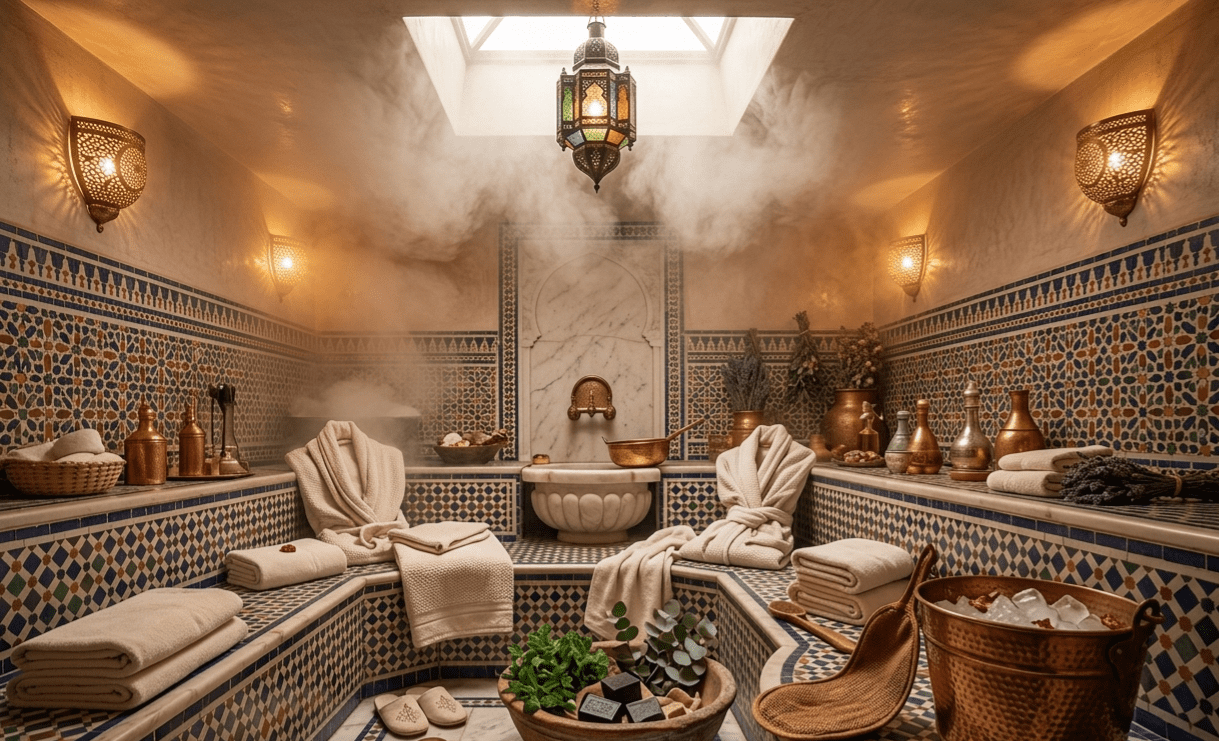
Steam System Requirement Moroccan Bath
The steam system is the technical soul of any Moroccan bath. Get it right and the hammam delivers the enveloping, moisture-rich heat that has defined North African bathing culture for over a thousand years. Get it wrong and you face undersized generators, structural moisture damage, condensation failures, and safety hazards. This guide covers every steam system specification required for a successful installation.
How Hammam Steam Works
A Moroccan bath steam system operates on fundamentally different principles from a Finnish sauna or a Turkish bath. Rather than superheated dry air or high-pressure industrial steam, the hammam uses low-pressure, saturated wet steam — sometimes called “soft steam” ( Steam System Requirement Moroccan Bath ) — that maintains continuous relative humidity between 90% and 100% at temperatures ranging from 40°C to 55°C.
The steam generator heats water in a sealed boiler tank using electric heating elements (or occasionally gas). When water reaches boiling point, it converts to steam and is delivered via insulated copper or stainless steel pipework to one or more steam heads mounted in the hammam room — typically near floor level to allow the steam to rise naturally and fill the space evenly from bottom to top.
Why Hammam Steam is Different from Sauna or Turkish Bath
A Finnish sauna operates at 70–100°C with 10–20% humidity — dry, fierce heat. A Turkish bath (hamam) uses wet steam at 40–50°C, similar to a Moroccan hammam, but is a single continuous steam room. The Moroccan hammam uniquely uses a three-zone temperature gradient (hot, warm, cool) with the steam primarily concentrated in the innermost hot room. The steam system must be designed to serve this zoned temperature model, not simply to fill the entire building with steam.
Steam Generator Sizing & kW Calculation
Correct steam generator sizing is the most critical technical decision in a Moroccan bath installation. An undersized generator cannot reach or maintain the required temperature and humidity. An oversized unit is wasteful, produces excessive condensation, and can cause structural damage from over-steaming.
Residential Self-Contained
Single-phase units for home hammam rooms. Built-in auto-flush, overheat protection, and dry-fire cut-out. Plug-and-play with standard plumbing connections.
Commercial Three-Phase
High-output units for hotel spas and commercial hammams. Remote control panels, multiple steam outlet ports, and programmable timed operation.
Networked / Manifold
Multiple generators operating in parallel via a manifold distribution system. Used for large commercial hammams where a single unit cannot provide sufficient output.
Aroma-Integrated
Generators with a built-in essential oil infusion chamber. Delivers eucalyptus, orange blossom, or menthol aromatics directly into the steam stream.
Temperature Zone Requirements
A traditional Moroccan hammam is divided into three progressive temperature zones, each with distinct steam system requirements. The steam generator and its distribution system must be designed to maintain these three independent climatic conditions simultaneously.
Steam Pipe Specifications
The steam distribution pipework connects the generator to the steam head(s) inside the hammam room. Correct pipe sizing, material selection, insulation, and installation are essential to prevent pressure drop, condensation pooling, and heat loss.
Pipe Material
Two materials are approved for hammam steam pipework. Copper (to BS EN 1057) is the standard for residential installations — it is easy to work, resistant to steam corrosion, and connects neatly to standard compression or push-fit fittings. Grade 316 stainless steel is specified for commercial installations where higher temperatures, longer pipe runs, and heavy daily usage make additional corrosion resistance necessary. Do not use plastic push-fit pipework for steam supply lines — even steam-rated plastic degrades under long-term steam condensate exposure.
Steam Head Positioning
The steam head (outlet nozzle) should be positioned 200–300 mm above floor level, on a side wall — never directly adjacent to a bench or bather position. This allows steam to rise naturally and distribute evenly throughout the room. For rooms over 12 m², two steam heads fed from a single manifold provide better distribution than one large-diameter outlet.
- Never use galvanised steel pipe — zinc coating degrades in steam environments, contaminating the steam and causing boiler scaling
- Avoid sharp 90° elbows — use swept bends (long-radius elbows) to minimise pressure drop and condensate trapping
- All joints below the generator must be accessible — use unions rather than permanent soldered joints at maintenance points
- Condensate return — pipe must fall back towards the generator at minimum 1:50 gradient to prevent water hammer and condensate pooling
- Insulate all pipework — uninsulated steam pipe loses up to 40% of thermal energy before reaching the room
Section 05
Waterproofing for Steam Environments
Steam environments are categorically more demanding than wet rooms or standard showers. Continuous 90–100% relative humidity and the phenomenon of steam condensation — where warm steam contacts cooler surfaces and converts back to liquid water — means that waterproofing for a Moroccan bath must be specified to a higher standard than any other domestic wet area.
Tanking System Specification
The industry-standard waterproofing system for Moroccan bath installation is a dual-component liquid tanking membrane applied in two full coats to all surfaces — floor, all four walls, and the ceiling. Popular systems include Schlüter Kerdi, BAL Tanking Kit (two-part), and Mapei Mapelastic. The membrane must be continuous — any break, gap, or omitted surface will eventually allow moisture to penetrate the building fabric.
- Substrate preparation: all surfaces must be solid, flat, and free from dust. New concrete must cure for minimum 28 days before membrane application
- Corner tapes and fillets: fabric-reinforced corner tapes embedded in the wet membrane at all internal corners — the highest-risk areas for stress cracking
- Pipe and fitting penetrations: steam-rated pipe collars or pre-formed sealing sleeves around every penetration — a major source of long-term failure if omitted
- Upstand at door threshold: minimum 150 mm waterproof upstand at the door opening before the threshold strip, to prevent water migration into adjacent spaces
- Separate vapour barrier: behind the structural substrate (in cavity or between studs) to prevent moisture reaching the building structure beyond the wetroom
- Flex adhesive & grout: all tile adhesives and grouts rated for continuous wet/steam use. Standard OPC cement grout absorbs moisture, grows mould, and fails within 2–3 years in a steam environment
Ventilation System Requirements
Ventilation is the most frequently underspecified element of a Moroccan bath steam system. Many installers design for the steam experience but neglect the post-session ventilation requirement — resulting in persistent condensation, accelerated tile grout failure, mould growth in ceiling domes, and structural moisture damage.
Minimum Ventilation Rate
A steam System Requirement Moroccan Bath room requires a minimum of 15 air changes per hour (ACH) through dedicated mechanical exhaust ventilation. Many specialist hammam designers specify 20 ACH or higher for commercial installations. To calculate the required fan flow rate:
Electrical & IP Rating Standards
All electrical components within a Moroccan bath steam room must comply with BS 7671 (IET Wiring Regulations) and specifically with Part 2 Zone requirements for steam rooms and swimming pool areas (Section 702 for pools and fountains is the closest applicable standard; steam rooms are governed by manufacturers’ IP ratings and BS 7671 Part 8 supplementary guidance).
Water Quality & Treatment
The quality of water supplied to the steam generator has a direct impact on its performance, maintenance requirements, and operational lifespan. Scale build-up from hard water is the primary cause of premature steam generator failure and one of the most common issues in Moroccan bath installations across the UK, UAE, and other hard-water regions.
Water Hardness Impact
In hard-water areas (above 200 mg/l calcium carbonate), calcium and magnesium deposits progressively coat the generator’s heating elements, reducing thermal efficiency, increasing energy consumption, and ultimately causing element failure. The standard recommendation is to supply the steam generator from a dedicated water softener or inline scale inhibitor.
- Water hardness test: test the mains supply before specifying treatment. Below 100 mg/l (soft) — standard scale inhibitor sufficient. 100–300 mg/l (moderate) — inline polyphosphate dosing recommended. Above 300 mg/l (very hard) — dedicated block salt water softener required
- Auto-flush function: all modern steam generators should be set to perform an automatic flush cycle after each session to remove mineral-rich residual water from the tank before it cools and deposits scale
- Annual descaling: even with softened water, a professional descaling service is recommended annually for residential units, and every 3–6 months for commercial units in continuous use
- Water supply pressure: maintain between 1.5 and 5 bar at the generator inlet. Below 1.5 bar — fit a pressure booster pump. Above 5 bar — fit a pressure reducing valve (PRV)
- Backflow prevention: a double-check valve must be installed on the water supply to the steam generator to comply with Water Regulations and prevent steam backflow into the mains supply
Safety & Regulatory Compliance
Moroccan bath steam systems carry specific safety obligations relating to thermal burns, steam pressure, electrical safety, and structural moisture. Both residential and commercial installations must meet applicable standards.
Essential Safety Devices
Overheat Cut-Out
All steam generators must have a manual-reset thermal cut-out set at maximum 60°C room temperature. Automatic reset overheat devices are not sufficient — they allow the generator to restart unattended after a fault.
60°C max · Manual-reset
RCD Protection
All circuits supplying the steam room must be protected by a 30 mA Residual Current Device (RCD). This is a mandatory requirement under BS 7671 for wet and steam areas.
30 mA · Type A RCD
Emergency Egress
Steam room doors must open outward (never inward) so that a bather who loses consciousness is not trapped against the door. A door pull cord or emergency release must be accessible from the floor.
Outward opening · Floor release
Session Timer
A mandatory maximum session timer — typically 30 minutes for residential and 45 minutes for commercial — automatically shuts off the steam generator to prevent dangerous overexposure.
30–45 min max session
What size steam generator do I need for a Moroccan bath?
Use the formula: 1 kW per 1 cubic metre of room volume. Add 20% for rooms with natural stone, marble, or tadelakt plaster, and 10% for each exterior wall. For a standard 2.0 × 2.5 × 2.4 m residential hammam (12 m³ × 1.0 + 20% = 14.4 kW), select the next available generator above 14.4 kW — typically a 15 or 18 kW unit. Always round up, never down.
What temperature should a Moroccan hammam steam room be?
A traditional Moroccan hammam operates in three zones. The hot room (bayt al-harara) runs at 40–55°C with 90–100% relative humidity. The warm room (bayt al-wastani) operates at 35–40°C. The cool room (bayt al-barid) is at ambient temperature, typically 20–25°C. For a single-room residential hammam, aim for 40–50°C measured at bench height in the hottest area of the room.