

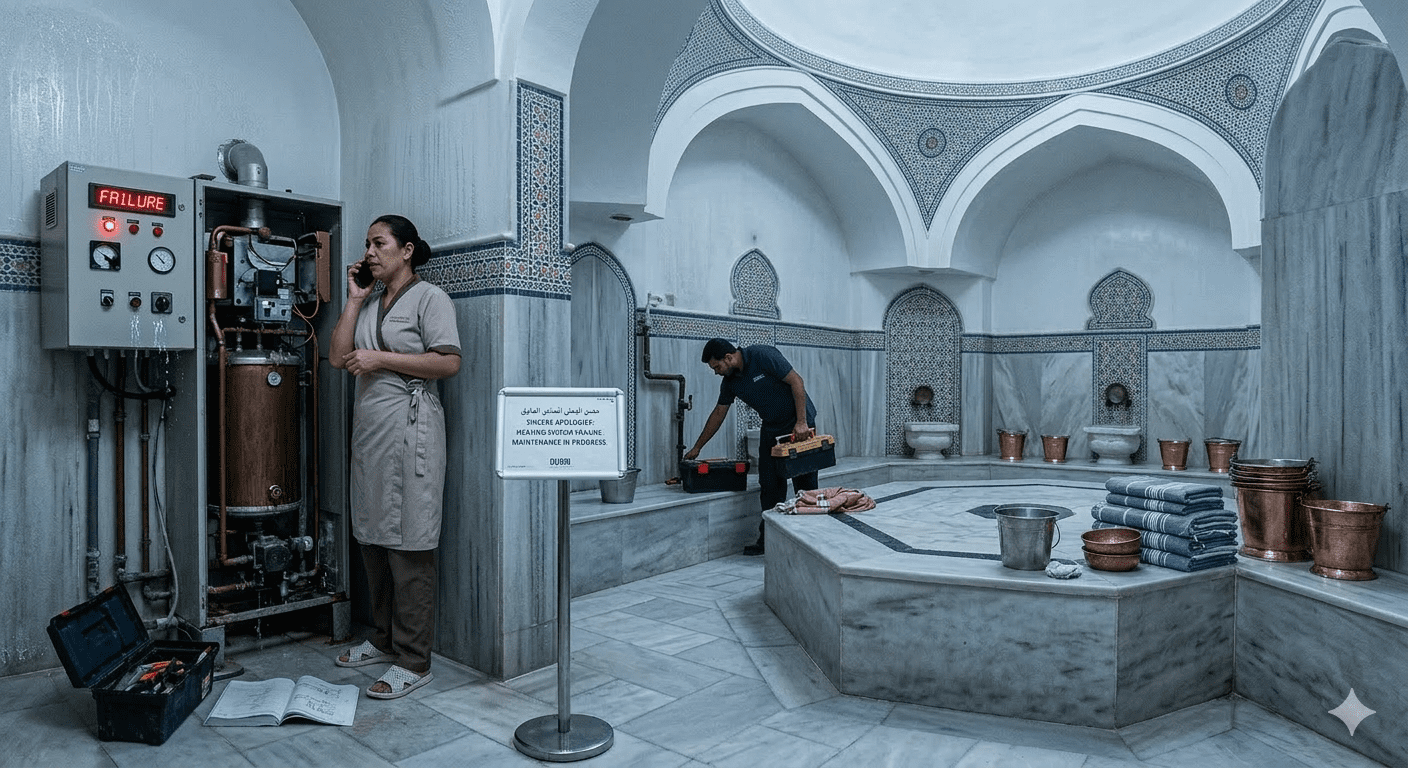
A hammam heating system is the heart of the entire wellness experience. Without it, there is no steam, no heat, no therapy — just an expensive, beautifully tiled room sitting idle. In the UAE, hammam heating systems are working harder than in almost any other country in the world. They contend with extreme ambient temperatures, exceptionally hard mineral-rich water, heavy daily usage, and in many properties, a maintenance routine that was designed for European conditions and has never been adapted for the UAE reality.
The result is premature failure. Boilers and steam generators that should last 10–15 years are breaking down in 3–5 years. Heating elements burn out mid-season. Pipes and valves become blocked with mineral scale. Pressure relief valves fail silently. And the repair or full-replacement costs land on property owners who believed their hammam was being looked after correctly.
This guide explains exactly why hammam heating systems fail prematurely in UAE properties, what the warning signs look like, and — most importantly — what a proper preventative maintenance programme involves. For professional hammam maintenance services in the UAE calibrated to local water and climate conditions, our team is ready to help.
Understanding Your Hammam Heating System
Before examining the causes of failure, it is useful to understand what a hammam heating system actually consists of — because different components fail for different reasons, and effective prevention must address each one.
COMPONENT | FUNCTION | PRIMARY UAE FAILURE RISK |
Steam Generator / Boiler | Heats water and produces steam at required pressure | Heating element burnout from unchecked limescale accumulation |
Heating Element | Electric resistance element that heats water in the tank | Scale coating insulates element → overheating → premature burnout |
Water Inlet & Solenoid Valve | Controls water supply into the generator tank | Mineral deposits cause valve seizure — restricted flow or no flow |
Pressure Relief Valve (PRV) | Safety release if system pressure exceeds safe limit | Scale or corrosion causes valve to stick — dangerous safety failure |
Steam Pipes & Distribution | Carries steam from generator to nozzles | Internal scale restriction reduces flow; external corrosion from condensate |
Steam Nozzles | Delivers steam into the hammam space | Complete blockage from mineral deposits — most visible early failure sign |
Control Panel & Thermostat | Manages temperature, timing and safety cutoffs | Sensor fouling from minerals causes inaccurate readings and misfire cycles |
Drain Valve & Tank Flush | Removes sediment and mineral-laden water from tank | Neglected flushing allows scale to reach critical levels rapidly in UAE |
Our experienced hammam heating specialists in Dubai inspect each of these components individually during a full system health check — identifying developing problems before they become failures.
The 6 Primary Causes of Premature Hammam Heating Failure in the UAE
Each cause below is common in UAE properties. In most failed systems, multiple causes are present simultaneously — they compound each other, and fixing one without addressing the others almost always leads to repeat failure.
Limescale Accumulation on the Heating Element
The single most common cause of premature failure across UAE hammam heating systems. When hard water is heated inside a steam generator, dissolved calcium carbonate precipitates out of solution and deposits directly onto the heating element. Over time, this scale coating acts as thermal insulation — the element must work progressively harder and hotter to heat the water through the thickening crust. Eventually it overheats, trips the safety cutoff repeatedly, and fails completely. • Stage 1 — Thin scale: heat-up time increases from 15 to 25+ minutes; power consumption rises noticeably • Stage 2 — Moderate scale: element begins localised overheating at scale hotspots; thermostat readings become unreliable • Stage 3 — Heavy scale: thermal runaway — safety cutoff trips repeatedly; element fails completely • In UAE TDS conditions of 400–600ppm, a generator with no descaling will typically reach Stage 3 within 18–24 months • With a quarterly descaling programme, the same element can operate effectively for 8–12 years
If your hammam is taking longer to heat up or tripping its safety cutoff repeatedly, do not wait — explore our hammam heating system repair and descaling services to have it assessed before the element fails completely.
Thermal Stress from Rapid Heating and Cooling Cycles
The UAE's air conditioning culture accelerates metal fatigue in every hammam heating component. Every time the heating system powers up from cold, every metal component expands as it reaches operating temperature. When it cools down — especially rapidly under full air conditioning — those components contract again. In a UAE property where the hammam is used daily and AC runs at near-maximum capacity between sessions, this expansion-contraction cycle is more severe and frequent than in almost any other climate on earth. • Thermal cycling fatigue causes micro-cracks at weld points, pipe joints and flange connections — invisible initially but progressive • Rapid temperature drops from cold water entering a hot tank — caused by a faulty solenoid valve — create thermal shock that can crack the tank lining • In UAE high-rise properties, rooftop plant rooms reach 60–70°C in summer, creating additional extreme thermal gradients on external pipe runs • Copper and stainless steel expand at different rates — at dissimilar-metal connections, differential movement gradually loosens joints and creates leak points
Voltage Fluctuations and Inadequate Electrical Protection
Frequently overlooked — but a significant factor in UAE steam generator heating element failures. UAE electrical supplies are generally reliable but voltage fluctuations — particularly in older buildings and during peak summer demand — are more common than most property owners realise. Steam generator heating elements are highly sensitive to supply voltage. Sustained overvoltage causes the element to run above its design rating, accelerating scale-baking and shortening element life. Under-voltage causes higher current draw and winding overheating. • Voltage spikes during power restoration after outages are a leading cause of immediate element failure — a generator without surge protection is vulnerable to every restoration event • Neutral conductor issues in older UAE building wiring cause intermittent overvoltage conditions that are invisible without instrumentation but cause cumulative damage • Many UAE hammam installations have no dedicated circuit breaker or surge protection device — an omission that costs very little to rectify but prevents very expensive failures • Under-voltage during peak summer demand hours causes the element to draw higher current, overheating its insulation and accelerating breakdown
Incorrect Water Pressure at the Generator Inlet
A silent cause of progressive damage across the entire heating system. Every steam generator is rated for a specific inlet water pressure range — typically 1.5 to 5.0 bar. In UAE properties, inlet pressure frequently exceeds this, especially in high-rise buildings and during off-peak hours. Sustained overpressure causes progressive damage to the solenoid valve, pressure relief valve, tank fittings and element flanges — damage that accumulates invisibly until a component fails. • Solenoid valve: excessive pressure causes premature valve seat wear — the valve eventually fails stuck-open (flooding the tank) or stuck-closed (no water supply, dry-fire risk) • Pressure relief valve: if system pressure regularly approaches the PRV setpoint, the valve begins to weep and eventually fails to reseat — a serious safety issue • Tank and fittings: repeated overpressure events stress welds and joints in ways that are not immediately visible but progressively weaken the system structure • Low inlet pressure causes the opposite — the tank does not refill quickly enough, leading to dry-fire risk if the level sensor has any fouling
Poor Original Installation and Commissioning
The failure nobody talks about — responsible for a significant proportion of UAE premature failures. A large number of UAE hammam heating failures trace back to errors made during the original installation — not equipment defects. The hammam sector has grown rapidly in the UAE and not every installation is carried out by technicians with specific steam generator training. Installation errors may not surface immediately but create failures within 2–4 years. • Incorrect pipe sizing: undersized steam outlet pipes create back pressure in the generator, raising operating temperatures and stressing seals and fittings • No pressure reducing valve: installation without a PRV on the cold water supply exposes the generator to full mains pressure, frequently exceeding the rated inlet limit • No surge protection: electrical installation without dedicated surge protection and correct fusing leaves the generator vulnerable to all voltage events • Wrong generator size: a generator undersized for the hammam volume must run at maximum capacity continuously — severely shortening component life • Incorrect condensate drainage: steam condensate pooling in pipes instead of draining back correctly causes water hammer and accelerated internal pipe corrosion
Inadequate or Absent Maintenance Programme
The most preventable cause — and responsible for the majority of early UAE hammam heating failures. Many UAE hammam owners follow the maintenance schedule in the manufacturer's manual, which is written for European or North American water conditions. In UAE hard water, annual descaling is equivalent to no descaling — scale has already reached Stage 2 or Stage 3 by the time the maintenance visit arrives. The entire maintenance calendar needs to be compressed to match UAE operating conditions. • Annual descaling in UAE conditions is wholly insufficient — quarterly is the minimum; monthly for commercial or high-usage properties • Pressure relief valves should be manually tested every 6 months and proactively replaced every 2–3 years — most UAE hammam PRVs have never been tested • Solenoid valves should be inspected and seals replaced quarterly — mineral deposits cause erratic operation and eventual seizure • The generator tank should be drained and flushed monthly to remove sediment before it consolidates into hard scale • Control panel sensors should be cleaned and calibrated annually — fouled sensors cause the system to operate outside design parameters without triggering alarms
Warning Signs — How to Recognise a Failing Hammam Heating System
Hammam heating systems rarely fail without warning. The symptoms below are progressive — recognising them early almost always means a lower repair cost. Waiting until the system stops working entirely typically means a full component replacement.
Early Warning Signs — Investigate Within 2 Weeks:
- Extended heat-up time — the hammam now takes 30–40 minutes to reach temperature when it previously took 15 minutes; almost always scale-related element degradation
- Reduced steam volume or pressure at the nozzles — indicates partial blockage from mineral deposits in the nozzles, pipes or generator outlet
- Higher electricity consumption — a scaling element draws progressively more power to maintain output; a noticeable increase in the hammam circuit’s energy use is a reliable early indicator
- Intermittent operation — the system cuts out mid-session and restarts; the safety thermostat is tripping due to element overheating
- Unusual gurgling or banging sounds — water hammer from condensate not draining correctly, or air entering through a degrading solenoid valve
Serious Warning Signs — Shut Down and Call a Technician Immediately:
- Repeated safety cutoff trips — more than once per week requires professional inspection before further use
- Water weeping from the pressure relief valve — system pressure is exceeding safe limits; take the generator offline immediately
- No steam output despite the generator heating normally — completely blocked outlet pipe or failed solenoid valve; continuing to run creates overheating risk
- Burning smell during operation — electrical insulation breakdown in the element windings; immediate shutdown; fire and electrocution risk
- Visible water leaks from pipe fittings or the generator body — requires professional assessment before any further use
7 Proven Steps to Prevent Premature Hammam Heating Failure
Prevention is dramatically more cost-effective than repair or replacement. Each step below is proven to extend hammam heating system life in UAE conditions — most are straightforward and inexpensive to implement once the correct maintenance calendar is established.
STEP 01 | Monthly Tank Flush and Quarterly Chemical Descale The single highest-impact maintenance action for any UAE hammam heating system. A monthly flush removes loose mineral sediment from the tank before it consolidates into hard scale. A quarterly chemical descale dissolves accumulated scale from the element and tank surfaces, restoring heating efficiency and element life. • Monthly flush: use the generator’s built-in drain valve to fully drain and refill the tank once — takes 20 minutes and removes sediment that would otherwise harden into scale • Quarterly descale: introduce a citric-acid-based appliance descaler through the water inlet, allow to circulate per the product specification, then fully flush the system • Never use muriatic acid, vinegar or non-approved products inside the generator — these cause internal corrosion and void most manufacturer warranties • Always run a full steam cycle after descaling to ensure all chemical residue is flushed from the system before the hammam is returned to use |
Unsure which descaler is approved for your specific generator model? Book a hammam maintenance assessment today— our technicians will advise on the correct product, procedure and maintenance schedule for your system.
STEP 02 | Install a Water Softener or Scale Inhibitor on the Generator Feed Line The most effective long-term protection against scale-related element failure. A dedicated water softener or inline scale inhibitor installed on the cold water feed removes or neutralises calcium and magnesium ions before they enter the heating system. In UAE water conditions, a treated feed can reduce scale formation by 70–90%. • Electronic scale inhibitor: fits on the inlet pipe in under an hour — no chemicals, no maintenance, no salt — uses electromagnetic pulses to alter the structure of mineral ions • Polyphosphate dosing cartridge: a small inline cartridge that releases scale inhibitor at a controlled rate — low maintenance, effective for residential and light commercial applications • Ion-exchange water softener: the most complete protection — requires salt refilling and periodic regeneration — recommended for high-use commercial hammams • Any scale inhibition is better than none in UAE conditions — even partial inhibition significantly extends element lifespan and reduces descaling frequency |
STEP 03 | Install a Pressure Reducing Valve and Surge Protection Device Two inexpensive components that each prevent one of the most common UAE hammam heating failures — and both are frequently absent from existing installations. • Pressure Reducing Valve (PRV): installs on the cold water inlet; set to 3.0–3.5 bar regardless of mains pressure; prevents solenoid valve wear, PRV nuisance tripping and tank overpressure — typically costs AED 150–400 and takes 30 minutes to fit • Surge Protection Device (SPD): installs in the generator’s dedicated electrical supply circuit; protects the heating element and control board from voltage spikes during power restoration events — costs AED 100–250 and is one of the most cost-effective single investments for any UAE hammam • Both components should be inspected annually — a PRV that has operated at the edge of its range for 3+ years should be replaced proactively |
STEP 04 | Quarterly Solenoid Valve and PRV Inspection Two of the most failure-prone components in a UAE hammam heating system are also among the cheapest to maintain — but only if inspected proactively rather than after failure. • Solenoid valve: close the isolation valve, remove the solenoid body, check the valve seat and rubber diaphragm for mineral deposits and wear — clean with approved descaler, reassemble, and replace rubber seals annually • Pressure relief valve test: manually operate the PRV test lever — water should flow freely and the valve should reseat completely with no residual drip; a weeping PRV requires immediate replacement • Document all inspections with date, findings and technician name — a maintenance log is required for Dubai Municipality compliance in commercial properties and supports any manufacturer warranty claim |
STEP 05 | Allow Gradual Cooling After Sessions — Avoid Immediate AC Shock A simple operational change that significantly reduces thermal stress on all generator components and substantially extends system lifespan. • After each hammam session, allow the generator to complete its programmed cool-down cycle before exposing the room to full air conditioning • Where possible, reduce the hammam HVAC from maximum cooling to a moderate setting for 20–30 minutes after the last session of the day — this reduces the thermal gradient the system experiences • In hotel and commercial operations, programme the hammam HVAC controller to a soft-cooling mode for 30 minutes post-session rather than immediate full-power cooling • Ensure the steam generator’s programmed post-session drain cycle is enabled — this removes residual hot water from the tank before the system fully cools, reducing scale consolidation on the element |
STEP 06 | Annual Professional Service by a Qualified Specialist Daily and monthly maintenance tasks can be handled in-house — but an annual professional service by a technician with specific steam generator training is non-negotiable for any UAE hammam, whether residential or commercial. • Annual service scope: heating element inspection and resistance test, full tank internal inspection, solenoid valve replacement if worn, control panel calibration, pressure test of all fittings and pipe joints, steam pipe internal check • Request a written service report after every professional visit — this documents each component’s condition, identifies developing problems early, and builds a maintenance history that supports warranty claims • For UAE hotel and commercial properties, the service provider should supply documentation that meets Dubai Municipality health and safety requirements • Annual service records also significantly increase property value — a fully documented hammam maintenance history is a tangible asset when selling a UAE property |
STEP 07 | Correctly Size Your Generator for Actual Usage Demand A generator running continuously at maximum capacity to heat a space it was undersized for is a generator that will fail early. Generator undersizing is one of the most common installation errors in UAE hammam projects — and one that no amount of maintenance can fully compensate for. • Correct sizing is based on the total volume of the hammam space, wall insulation quality, target operating temperature and the frequency and duration of daily use • For a typical UAE residential hammam of 4–8 sqm with well-insulated walls, a 6–9 kW generator is usually appropriate — installations with 3–4 kW generators in these spaces are running permanently stressed • For commercial hammams or large residential spaces, get a professional sizing calculation — manufacturer online tools are a starting point but do not account for UAE-specific heat loss factors • If your generator runs continuously at maximum output and still struggles to reach target temperature, it is undersized — adding a second generator in parallel is often more cost-effective than repeatedly repairing a failing undersized unit |
Complete Maintenance Schedule for UAE Hammam Heating Systems
Use this schedule as your standard operating reference. For hammams in continuous commercial use — 8+ hours daily — apply the highest-frequency intervals throughout.
FREQUENCY | WHO | MAINTENANCE TASKS |
After every use | Operator | Run generator post-session drain and cool-down cycle; visually check nozzles for blockage; report any error codes |
Weekly | Operator | Check steam output volume and pressure; inspect nozzles and clean with damp cloth; confirm no error codes on control panel |
Monthly | Operator / Technician | Full tank drain and flush to remove sediment; check water inlet pressure with gauge; clean accessible solenoid strainer filter |
Quarterly | Specialist Technician | Chemical descale of tank and element; solenoid valve inspection and seal replacement; PRV manual test; sensor calibration check |
Bi-annually | Specialist Technician | Steam pipe internal inspection; check all pipe joints and fittings for weeping; full electrical supply check including SPD test |
Annually | Specialist Technician | Full professional service — element resistance test, complete tank inspection, system pressure test, written condition report; replace PRV if 3+ years old |
The Cost of Ignored Maintenance — UAE Hammam Repair Benchmarks
Every maintenance investment described in this guide costs a fraction of the repair it prevents. The table below shows typical UAE repair and replacement costs against the maintenance action that eliminates each failure.
FAILURE TYPE | REPAIR COST (AED) | PREVENTION |
Heating element replacement (scale burnout) | AED 800–2,500 | Quarterly descaling + monthly tank flush |
Solenoid valve replacement (mineral seizure) | AED 400–1,200 | Quarterly solenoid inspection and seal replacement |
Pressure relief valve replacement | AED 300–900 | Bi-annual PRV test; proactive 3-year replacement schedule |
Control board replacement (voltage spike damage) | AED 1,500–4,500 | Dedicated surge protection device on electrical supply |
Steam generator tank replacement (corrosion) | AED 4,000–15,000 | Annual inspection; monthly flush; scale inhibitor on feed line |
Full generator replacement (multiple failures) | AED 8,000–35,000 | Complete systematic prevention programme — all steps above |
Emergency call-out (mid-session failure) | AED 600–1,500 | Scheduled maintenance eliminates reactive call-outs entirely |
Commercial hammam closure (revenue loss per day) | AED 2,000–10,000+ | Uptime-focused prevention programme; no unplanned downtime |
Hammam heating systems fail prematurely in the UAE for six primary reasons: limescale accumulation on the heating element, thermal stress from rapid temperature cycling, voltage fluctuations and inadequate electrical protection, incorrect water inlet pressure, poor original installation, and insufficient maintenance frequency. Every single one of these causes is preventable — and prevention costs a fraction of what repair or full replacement demands.
The UAE’s hard water, extreme ambient temperatures and high daily usage patterns mean that the standard maintenance schedule from a generator manufacturer’s manual is not sufficient. What works as an annual maintenance task in Germany needs to happen quarterly in Dubai. What is a three-year replacement interval for a pressure relief valve in the UK is a two-year interval in the UAE. Adapting your maintenance programme to the actual conditions your system operates in is not optional — it is the difference between a hammam that performs reliably for a decade and one that breaks down repeatedly within three years.
If you are unsure whether your current programme is adequate — or if your system is already showing any of the warning signs in this guide — connect with our UAE hammam installation and heating experts who understand the specific demands of the UAE environment and can design a maintenance schedule that genuinely protects your investment.
Ready to protect your investment? Contact our hammam team for a free quote — we will assess your system and provide a tailored maintenance proposal within 24 hours.
Frequently Asked Questions
How often should a hammam steam generator be descaled in Dubai?
In Dubai and across the UAE, a hammam steam generator should be chemically descaled at minimum every three months — quarterly. This is significantly more frequent than the annual descaling schedule typically recommended in generator manufacturer manuals, which are written for soft or medium-hardness water in Europe or North America. Dubai tap water has Total Dissolved Solids levels of 400–600 ppm or higher, meaning scale accumulates on the heating element approximately four times faster than in a standard European installation. In addition to quarterly chemical descaling, the generator tank should be drained and flushed monthly to remove loose mineral sediment before it consolidates into hard scale. For commercial hammams operating 8 or more hours daily, monthly descaling is strongly recommended rather than quarterly.
What are the most common signs of a failing hammam heating system in the UAE?
The most common early warning signs of a failing hammam heating system in the UAE are: significantly extended heat-up time — the room now taking 30–40 minutes to reach operating temperature when it previously took 15; noticeably reduced steam volume or pressure from the nozzles; the generator cutting out mid-session and requiring a reset, which indicates the safety thermostat is tripping due to element overheating; unusual gurgling or banging sounds from the pipes or generator; and higher than usual electricity consumption from the hammam circuit. More serious warning signs that require immediate shutdown include: water weeping from the pressure relief valve; a burning smell during operation; visible water leaks from pipe fittings or the generator body; repeated safety cutoff trips that do not stay reset; and error codes on the control panel that do not clear after a restart. None of these symptoms should be ignored — the earlier they are investigated, the lower the resulting repair cost.
How long should a hammam steam generator last in UAE conditions?
A quality hammam steam generator that is correctly sized for the space, properly installed with a pressure reducing valve and surge protection device, and maintained on a UAE-appropriate schedule — quarterly descaling, monthly tank flush and annual professional service — should last 10–15 years before major component replacement is required. Without this maintenance, the same generator in UAE hard water conditions will typically experience heating element failure within 18–36 months and full system failure within 3–6 years. The single most significant factor affecting generator lifespan in the UAE is descaling frequency. Generators that are descaled quarterly last three to five times longer than those descaled annually or not at all. Adding a water softener or scale inhibitor to the feed line can extend system lifespan to 15 years or beyond in well-maintained installations.
Can hammam generator descaling be done at home in the UAE, or does it need a professional?
Monthly tank flushing — draining the generator and refilling once to remove loose sediment — is a straightforward task that can be carried out by a confident property owner following the generator’s operating manual. However, quarterly chemical descaling of the heating element is strongly recommended to be performed by a qualified technician for two reasons. First, the correct descaling product must be matched to your specific generator brand and model — using an inappropriate product can damage internal components and void the manufacturer warranty. Second, a professional descaling visit allows the technician to visually inspect the element, test the solenoid valve, check the pressure relief valve, and identify any developing problems that are not visible without disassembly. For commercial properties in Dubai, all maintenance must be professionally documented for Dubai Municipality compliance purposes. DIY monthly flushing is encouraged as a supplementary task between quarterly professional descale visits — not as a replacement for professional service.
How much does hammam heating system maintenance cost in Dubai?
The cost of professional hammam heating system maintenance in Dubai varies by generator type and scope of work. As a general guide: a quarterly professional descale, solenoid valve inspection and PRV test for a standard residential hammam generator typically costs AED 400–800 per visit. An annual full professional service — including element resistance test, tank inspection, steam pipe check, electrical supply verification and written condition report — typically costs AED 800–1,800 for a residential system and AED 1,500–3,500 for a commercial system with compliance documentation requirements. Emergency call-out service for an active failure typically costs AED 600–1,500 plus parts. A complete annual maintenance programme covering all quarterly visits and the annual full service typically costs AED 2,000–4,500 for a residential hammam and AED 4,000–10,000 for a high-usage commercial installation. These figures are significantly lower than the cost of a single premature generator replacement, which ranges from AED 8,000 to AED 35,000 including installation and any necessary ancillary repairs.