

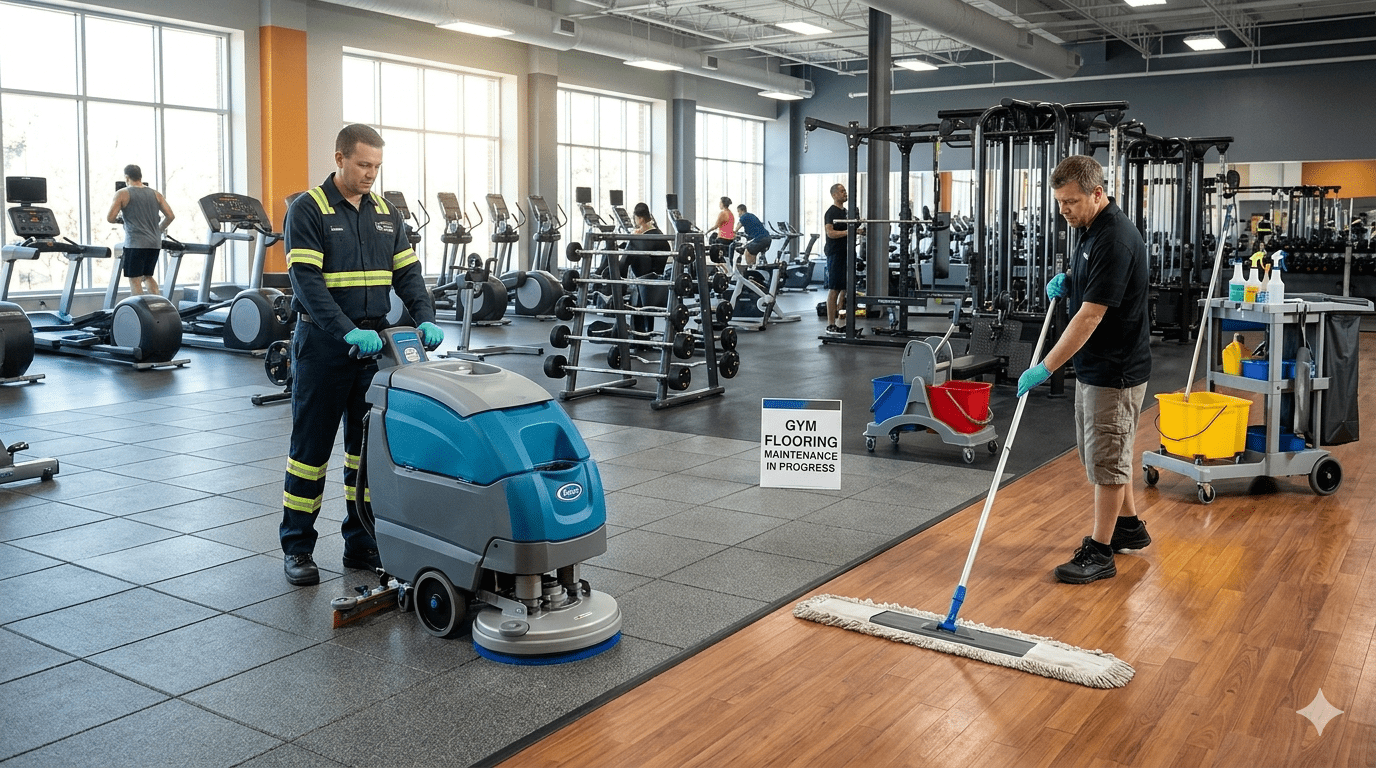
Gym flooring maintenance in UAE properties is one of the most urgent — and most underestimated — challenges facing gym operators, facility managers and property owners across Dubai and the Emirates today. Rubber gym flooring that performs perfectly in cooler months begins to buckle, lift, gap and degrade as UAE summer temperatures push past 45°C. The consequences are real: equipment becomes unstable on uneven surfaces, members trip on raised tile edges, cleaning grows more difficult as grit infiltrates joints — and eventually, an expensive commercial gym floor fails years before it should.
Proper gym flooring maintenance in UAE conditions requires more than a daily mop. It demands an understanding of why rubber behaves differently in extreme heat, what installation choices make the difference between a floor that lasts and one that fails, and what a systematic maintenance schedule looks like when it is calibrated for the UAE’s unique climate — not copied from a European manual.
This guide covers everything: the five causes of rubber gym floor warping specific to the UAE, seven proven prevention steps, a complete cleaning product reference, and a full maintenance schedule. For immediate gym flooring maintenance services in the UAE tailored to local conditions, our team covers Dubai, Abu Dhabi and across the Emirates.
Gym Flooring Maintenance UAE: Understanding Your Rubber Type First
Effective gym flooring maintenance in UAE facilities begins with knowing exactly what type of rubber is on your floor — because the heat tolerance, adhesive requirement and correct maintenance approach differ significantly between rubber types. Using the wrong cleaning product or adhesive for your specific rubber compound will accelerate every failure mode described in this guide.
RUBBER TYPE | HEAT TOLERANCE | UAE WARP RISK | RECOMMENDED FOR UAE? |
Vulcanised SBR rubber roll | Good — up to 60°C | Low–Medium | ✓ Yes — commercial gyms |
Virgin rubber tiles | Good — up to 60°C | Low | ✓ Yes — all UAE applications |
EPDM rubber tiles (coloured) | Good — UV and heat stable | Low | ✓ Yes — outdoor and coloured zones |
Interlocking recycled rubber | Moderate — up to 50°C | Medium | ⚠ Caution — avoid solar-exposed zones |
Recycled crumb rubber tiles | Poor — softens above 45°C | High | ✗ Not recommended for UAE gyms |
Foam / EVA hybrid tiles | Poor — deforms above 40°C | Very High | ✗ Not suitable for UAE commercial use |
5 Causes of Rubber Warping — The Root Problems Behind UAE Gym Flooring Maintenance Challenges
Every gym flooring maintenance challenge in UAE properties traces back to one or more of these five causes. Identifying the correct cause before attempting repairs is essential — re-bonding a lifted tile without understanding why it lifted guarantees the same failure recurs within weeks.
CAUSE 01 | Thermal Expansion Without Adequate Perimeter Expansion Gaps The most widespread installation error behind UAE gym flooring maintenance problems. Rubber expands when heated. A standard 1m × 1m rubber tile expands by 1–2mm per side between a UAE winter temperature of 18°C and a summer temperature of 45°C. Across a 200 sqm gym floor with 20 tiles per row, this cumulative expansion amounts to 20–40mm — and if the floor has no room to expand, it buckles upward. This is the most common cause of gym flooring maintenance problems in UAE commercial and residential properties. • Most UAE gym floors are installed without adequate perimeter expansion gaps — the floor cannot expand and warps under thermal load • Interlocking rubber tiles create a rigid grid that amplifies thermal expansion stress — without gaps, the force concentrates at the weakest tile edges • Required UAE specification: 8–10mm perimeter expansion gaps at all walls and fixed obstacles — gaps smaller than this are inadequate for UAE climate • Rolled rubber flooring without perimeter relief gaps buckles in its longest dimension — producing the characteristic ridge pattern seen in UAE gym roll flooring failures • This single installation omission is responsible for the majority of gym flooring maintenance calls received across Dubai and Abu Dhabi |
If your UAE gym floor is buckling at the perimeter or developing ridge patterns, inadequate expansion gaps are likely the cause. Our professional rubber gym flooring repair team in Dubai can assess whether perimeter relief cutting or full re-installation is required.
CAUSE 02 | Direct Solar Heat Loading Through Gym Windows and Skylights A UAE-specific driver of accelerated rubber degradation — and a critical gym flooring maintenance consideration. Dark rubber flooring absorbs solar radiation efficiently, reaching surface temperatures of 60–70°C in direct sunlight during UAE summer peak hours. At these temperatures, recycled crumb rubber begins to soften and deform, adhesive bonds begin to creep, and UV degradation of the rubber compound surface accelerates dramatically. In UAE gym flooring maintenance, solar exposure is a factor that European maintenance guides entirely fail to address. • East-facing gym windows produce intense morning solar loading — flooring within 2–3 metres of east-facing glass shows the earliest and most severe heat damage • Skylights create discrete warped patches — circular or rectangular lifting zones directly below each skylight position • Light-coloured EPDM or beige rubber reflects significantly more solar radiation — specifying lighter flooring for solar-exposed UAE gyms dramatically reduces heat loading • Reflective window film reduces solar heat transmission by 40–80% and is the most cost-effective single investment for protecting rubber gym flooring in UAE solar-exposed facilities • UV radiation from direct sunlight causes surface brittleness and colour fading independently of warping — both require replacement rather than maintenance remediation |
CAUSE 03 | Wrong Adhesive or Degraded Bond — A Core UAE Gym Flooring Maintenance Issue The silent cause that converts manageable thermal expansion into structural floor failure. Rubber gym flooring installed without adhesive — loose-lay — almost always fails in UAE conditions. The thermal expansion forces generated at 45°C+ exceed the frictional resistance holding the floor in place, and tiles migrate and buckle. Bonded installations fail when the wrong adhesive is used. Standard acrylic contact adhesives soften above 40°C, losing bonding strength precisely when UAE summer temperatures peak. This is one of the most consequential and most frequently misunderstood aspects of gym flooring maintenance in UAE commercial properties. • Standard acrylic adhesive: softens above 40°C — loses significant bonding strength during UAE summer; tiles slide and buckle under thermal load • High-temperature polyurethane adhesive: the correct specification for UAE gym flooring — retains bond strength to 70°C+; essential for long-term floor integrity • Adhesive coverage of less than 90% of the tile back area creates unsupported zones that delaminate under equipment load and heat cycling • Any loose-lay installation in a UAE gym should be considered at permanent risk of warping during summer months — full bonding with high-temperature adhesive is the correct specification |
Lifting tiles and edge gaps caused by adhesive failure require professional re-bonding with the correct adhesive system. We provide commercial gym flooring installation and repair across the UAE using high-temperature polyurethane adhesive rated for UAE climate conditions.
CAUSE 04 | Moisture Infiltration from Subfloor or Air Conditioning Condensation A frequently overlooked secondary cause of UAE gym flooring delamination and bubbling. Rubber gym flooring requires a dry, stable subfloor for the adhesive bond to perform correctly. In UAE buildings — particularly ground-floor gyms, basement fitness rooms and any gym space adjacent to pool facilities — moisture can migrate through the concrete subfloor from below. UAE’s heavy air conditioning use also creates condensation at floor level when very cold surfaces meet warm, humid incoming air. Both attack the adhesive layer, causing tiles to lift and bubble in patterns that can be mistaken for thermal warping during routine gym flooring maintenance inspections. • Ground-floor and basement gyms in UAE buildings are the highest-risk locations — always specify a two-component epoxy moisture barrier as part of the flooring installation • Condensation at floor level is most visible in UAE summer mornings when external humidity is high and gyms are cooled overnight — appears as beading across the floor surface • Moisture-damaged adhesive produces characteristic bubbling — circular raised areas that feel soft when pressed and produce a hollow sound when tapped • A subfloor relative humidity test (above 75% RH) requires treatment with an epoxy moisture barrier before any new gym floor installation proceeds |
CAUSE 05 | Poor Subfloor Preparation — The Foundation of All UAE Gym Flooring Maintenance Failures A poorly prepared subfloor guarantees future warping regardless of flooring quality or maintenance effort. Rubber gym flooring requires a flat, level, clean and structurally sound subfloor. UAE commercial properties — particularly converted spaces, older residential towers and repurposed retail units — frequently have subfloors with surface lippage, residual adhesive contamination from previous floor finishes, or structural cracks. Installing rubber gym flooring over any of these conditions without remediation creates stress concentration points that manifest as warping under thermal cycling and equipment loads — and cannot be resolved by gym flooring maintenance alone. • Acceptable lippage tolerance for rubber gym flooring: 3mm over a 3-metre straight edge — greater variation requires grinding or self-levelling compound • Residual adhesive from previous floor finishes prevents uniform bond adhesion — it must be fully removed before new adhesive is applied • Untreated concrete cracks telegraph through to the rubber surface as raised linear ridges — require epoxy crack repair before flooring installation • UAE concrete subfloors in older buildings often have surface carbonation that reduces adhesion — light mechanical scarification before adhesive application significantly improves bond performance |
7 Proven Solutions: UAE Gym Flooring Maintenance Steps to Stop Rubber Warping
These seven steps form the complete gym flooring maintenance framework for UAE properties. Steps 1 and 2 can be implemented today at zero cost. Steps 3–7 apply to both existing installations needing remediation and new projects at the specification and installation stage.
Maintain Minimum Overnight Temperature — The Free Gym Flooring Maintenance UAE Win
The single highest-impact zero-cost step in any UAE gym flooring maintenance programme. Allowing a gym to heat to 35–40°C+ during closed hours — then rapidly cooling with air conditioning on opening — subjects the rubber floor to a full high-to-low thermal cycle every single day. Across six months of UAE summer, this daily cycle accumulates significant fatigue in the adhesive bond and rubber compound. • Set gym HVAC to maintain a minimum overnight temperature of 26°C — this prevents rubber from reaching the critical expansion threshold during closed hours • Pre-cool to 24°C at least 2 hours before opening — the floor reaches operating temperature gradually rather than experiencing rapid contraction • Even a basic time-controlled thermostat prevents the worst daily cycling — invest in overnight temperature control before any other gym flooring maintenance UAE measure • In rooftop plant rooms and spaces with poor building envelope insulation, add reflective insulation to the ceiling to reduce solar heat loading on the floor below
Install Solar Control Window Film — Critical UAE Gym Flooring Maintenance Protection
If your gym receives direct sunlight on the floor surface, solar control window film is the single most cost-effective investment in long-term UAE gym flooring maintenance. It reduces solar heat transmission by 40–80%, dramatically lowering peak floor surface temperatures in solar-exposed zones — the primary driver of adhesive creep and rubber surface degradation. • Specify external solar film with a Solar Heat Gain Coefficient (SHGC) of 0.25 or lower — this blocks 75%+ of solar heat before it enters the building • For skylights: a white or reflective suspended panel 300–400mm below the skylight face blocks direct radiation without reducing natural light significantly • Solar roller blinds on east and west-facing windows, closed during peak solar hours, provide strong protection without permanent film installation • In new UAE gym fit-outs, specifying low-e double glazing eliminates solar floor loading at source — far more cost-effective than repeated gym flooring maintenance UAE interventions
Cut Adequate Expansion Gaps — The Most Common Gap in UAE Gym Flooring Maintenance
If your existing floor has no expansion gaps or gaps under 5mm at the perimeter walls, this is the direct cause of any current buckling. For an existing installation, perimeter relief cuts can be made using a circular saw. For new installations, specify and maintain 8–10mm perimeter gaps throughout the fitting process — this is standard gym flooring maintenance UAE practice for heat-rated installations. • Required perimeter gap for UAE climate: 8–10mm at all walls and fixed obstacles (European specification of 5mm is insufficient in UAE summer temperatures) • Use a circular saw set to flooring thickness only — do not score into the adhesive or subfloor below • Cover expansion gaps with flexible rubber skirting profiles — never fill with rigid grout, caulk or hard trim; the gap must remain flexible • Re-check expansion gap clearance as part of every annual gym flooring maintenance UAE inspection — compressed or infilled gaps are the most common reason a previously well-performing floor begins to buckle
Not sure if your current expansion gaps are adequate for UAE conditions? Book a gym flooring maintenance inspection today — our specialists will assess every gap, tile joint and perimeter condition across your facility.
Re-Bond with High-Temperature Adhesive — Essential UAE Gym Flooring Maintenance Material Specification
Any gym flooring maintenance UAE re-bonding work must use a high-temperature polyurethane adhesive rated for continuous operation at 70°C minimum. Re-bonding lifting tiles with standard acrylic adhesive in UAE conditions is a temporary fix that fails within weeks — the adhesive softens at the same temperature that caused the original failure. • Spot repair of individual lifting tiles: clean the old adhesive from tile back and subfloor face completely; apply high-temperature PU adhesive with 90%+ coverage; weight down for 24 hours • Section re-bonding: lift all tiles in affected area; scrape subfloor clean; apply moisture barrier if required; cure before re-laying with high-temperature adhesive • Apply adhesive in early morning when temperatures are lowest — adhesive applied at 35°C+ has a shorter open time and may cure before tiles are correctly positioned • Weight tiles with sandbags or equipment for 24 hours minimum after bonding — inadequate curing time is the leading cause of re-bonding failures in UAE gym flooring maintenance
Clean Correctly — Protect the Rubber Compound and Adhesive Bond
Incorrect cleaning products accelerate every gym flooring maintenance UAE failure mode — they soften the rubber surface, attack adhesive at tile joints and draw moisture into the floor structure. Many UAE commercial cleaning teams use solvent-based or bleach-based multi-surface cleaners on rubber gym flooring — this is one of the most common avoidable causes of premature rubber degradation in UAE gym properties. • Use alkaline rubber floor cleaner at pH 8–10 for all routine mopping — available from commercial cleaning suppliers across the UAE • Rinse thoroughly with clean water after every cleaning session — residual cleaning solution left on the surface attacks adhesive at joints • Never use solvent-based cleaners, bleach, citrus degreasers or alcohol-based disinfectants on rubber gym flooring — all degrade the rubber compound and soften the adhesive • For disinfection, use a QAC-based (quaternary ammonium compound) disinfectant specifically formulated to be rubber-safe • Allow the floor to dry completely before the gym opens — cleaning immediately before heavy use traps moisture under equipment feet
Quarterly Inspection and Annual Professional Gym Flooring Maintenance UAE Assessment
Systematic gym flooring maintenance in UAE properties requires documented inspection at defined intervals. Warping and delamination are progressive — they develop through accumulated small stress events. A quarterly visual inspection catches early-stage lifting and joint failure before significant structural damage occurs. An annual professional assessment documents floor condition and identifies sections approaching end-of-life. • Quarterly inspection checklist: check all perimeter gaps (clear and unobstructed?); tap-test any raised areas (hollow = delamination); inspect all tile joints for gapping or sand infiltration; check flexibility of skirting profiles • Mark any areas of concern with removable tape and photograph — maintain a photo log to track deterioration over time • Annual professional assessment: subfloor moisture readings at grid points; full tap test of all tiles; adhesive pull-test in suspect areas; floor flatness measurement in heavy-use zones • Documentation of all gym flooring maintenance UAE inspections and repairs protects commercial operators in any member trip-and-fall liability claim
Apply a Subfloor Moisture Barrier — Non-Negotiable UAE Gym Flooring Maintenance Practice
For any new rubber gym floor installation or section replacement in a UAE property, a subfloor moisture assessment and epoxy barrier treatment is a non-negotiable element of gym flooring maintenance UAE best practice — particularly in ground-floor, basement and pool-adjacent gym spaces. • Conduct a digital RH probe test before any installation — subfloor moisture above 75% RH requires epoxy barrier treatment before flooring adhesive is applied • Apply a two-component epoxy moisture barrier to the entire subfloor area — eliminates upward moisture migration from the concrete slab • Allow 48 hours minimum cure time for the moisture barrier before applying gym flooring adhesive — premature application creates a bond sandwich that fails rapidly • In pool-adjacent gym spaces, a full waterproofing membrane system is required — standard moisture barriers alone are insufficient against pool water infiltration
Gym Flooring Maintenance UAE: Cleaning Products — What to Use and What to Avoid
Choosing the right cleaning products is as important as any structural maintenance step in UAE gym flooring maintenance. The wrong cleaner accelerates rubber compound degradation, softens adhesive at tile joints and draws moisture into the floor structure — all of which contribute directly to warping and premature floor failure.
SURFACE | ✓ SAFE TO USE | ✗ NEVER USE |
Standard rubber / vinyl flooring | Alkaline rubber floor cleaner pH 8–10; diluted neutral soap | Solvent-based cleaners; bleach; citrus degreasers |
Interlocking tile joints | Soft brush with diluted floor cleaner; compressed air blow-out | Pressure washing into joints — forces water under tiles |
Stubborn marks and scuffs | Rubber floor eraser; mild alkaline paste on spot only | Acetone, paint thinner or nail varnish remover |
Post-exercise sweat residue | Neutral pH mop with clean water; microfibre mop head | Leaving residue — salt from sweat attacks tile joint adhesive |
Adhesive or tape residue | Citrus adhesive remover — spot use only; rinse thoroughly | Wide-area solvent application — attacks floor adhesive bond |
Disinfection (hygiene protocol) | QAC-based disinfectant — rubber-safe formulation | High-concentration alcohol disinfectants — dries and cracks rubber |
Heavy soiling / construction dust | Rotary scrubber with rubber-safe solution; vacuum grit first | Wet mop alone — redistributes grit acting as abrasive under equipment |
Complete Gym Flooring Maintenance UAE Schedule — Daily to Annual
Use this schedule as the definitive gym flooring maintenance UAE reference for your facility. Adapt frequency to usage — a commercial gym running 12+ hours daily should apply the most frequent intervals across all categories.
FREQUENCY | TIME | TASKS |
Daily | 5–10 min | Damp mop with alkaline rubber cleaner; vacuum all tile joints; check for new lifting or gaps; clean perimeter skirting |
Weekly | 20–30 min | Full wet-mop clean; inspect tile joints for sand and grit infiltration; verify expansion gaps are clear; clean under all moveable equipment |
Monthly | 45–60 min | Deep mop with rotary scrubber; check all perimeter gaps are unobstructed; tap-test any raised tiles; inspect skirting profiles for separation |
Quarterly | 1.5–2 hrs | Full visual and tap-test inspection of all tiles; photograph any areas of concern; check adhesive condition on lifting edges; verify expansion gaps |
Bi-annually | 2–3 hrs | Specialist moisture reading of subfloor at grid points; adhesive pull-test in high-use zones; floor flatness measurement; photographic condition report |
Annually | Half day | Professional deep clean; full section-by-section condition assessment; re-bond lifting tiles with high-temperature adhesive; replace damaged skirting; update maintenance log |
Gym Flooring Maintenance UAE: Repair vs Replace Decision Guide
Not every warped UAE gym floor requires full replacement — many can be restored to full performance with targeted repairs if the damage is caught early. The correct decision depends on the extent of damage, the rubber type and whether the root cause can be practically resolved through gym flooring maintenance.
CONDITION | DECISION | ACTION |
1–5 tiles lifting at edges; subfloor dry | Repair | Re-bond with high-temperature PU adhesive; cut perimeter gap if absent |
Section lifting; adhesive degraded uniformly | Section replace | Lift full section; prepare subfloor; re-lay with correct spec adhesive |
Recycled crumb rubber softening / deforming | Replace | Specification failure — replace with vulcanised SBR or virgin rubber |
Widespread delamination over 30%+ of floor area | Full replace | Spot repairs will not hold — full replacement with correct spec and moisture barrier |
Subfloor moisture damage visible through floor | Replace + treat | Epoxy moisture barrier required before any new gym flooring installation |
Surface cracking and brittleness from UV exposure | Replace | UV degradation is irreversible — also install solar film on glazing |
Joint gapping across entire floor but tiles flat | Assess first | May be thermal expansion only — add perimeter gaps before deciding on replacement |
Buckled roll flooring in bonded installation | Assess | If adhesive uniformly degraded: full replace. If localised: re-bond section |
Gym Flooring Maintenance UAE: Protect Your Investment Year-Round
Gym flooring maintenance in UAE properties requires a different level of commitment, specification and care than most markets in the world. The UAE’s combination of extreme ambient heat, intense solar radiation, hard water and heavy air conditioning cycling creates conditions that stress every component of a rubber gym floor — from the compound itself to the adhesive bond and the subfloor beneath it.
The five causes of rubber warping identified in this guide — thermal expansion without gaps, solar heat loading, wrong adhesive, moisture infiltration and poor subfloor preparation — are all preventable. The seven prevention steps — overnight temperature control, solar film, perimeter expansion gaps, high-temperature adhesive, correct cleaning products, moisture barrier treatment and systematic quarterly inspections — address each cause directly. Implement them as your standard gym flooring maintenance UAE protocol and your rubber floor will deliver reliable, safe performance for 10–15 years.
The most expensive gym flooring maintenance in UAE properties is the reactive kind — emergency repairs, partial replacements and ultimately full floor renewals driven by failures that could have been prevented at a fraction of the cost. The right time to invest in a proper gym flooring maintenance UAE programme is before the floor shows significant signs of distress.
For expert gym flooring maintenance UAE specialists who understand the local climate, material specifications and maintenance requirements, our team is ready to assess your facility and design a maintenance programme that genuinely works in UAE conditions.
Ready to stop your rubber gym floor warping? Get a free gym flooring assessment — we visit your facility, assess the full floor condition and provide a written maintenance and repair proposal within 48 hours.
Frequently Asked Questions — Gym Flooring Maintenance UAE
What is the best approach to gym flooring maintenance in UAE properties to prevent rubber warping?
The most effective gym flooring maintenance in UAE properties combines three pillars: correct product specification, proper installation and a systematic ongoing care schedule. For product specification, use vulcanised SBR or virgin rubber rated to 60°C+ — not recycled crumb rubber, which softens above 45°C. For installation, ensure 8–10mm perimeter expansion gaps, high-temperature polyurethane adhesive with 90%+ coverage, and an epoxy moisture barrier on ground-floor and pool-adjacent gym subfloors. For ongoing gym flooring maintenance UAE care, maintain a minimum overnight gym temperature of 26°C to prevent extreme daily thermal cycling, install solar control film on any windows with direct floor exposure, and follow a quarterly inspection schedule that catches lifting tiles, joint gaps and adhesive failure before they develop into structural floor problems. A well-implemented gym flooring maintenance UAE programme keeps rubber performing reliably for 10–15 years in even the most demanding UAE commercial gym environments.
How often should gym flooring maintenance in UAE commercial gyms be carried out?
Gym flooring maintenance in UAE commercial gyms should follow a multi-frequency schedule. Daily: damp mopping with alkaline rubber cleaner and visual check for new lifting or gaps. Weekly: full wet-mop clean, joint inspection for sand and grit infiltration, expansion gap verification. Monthly: deep rotary scrub, tap-test of any suspect raised areas, skirting profile inspection. Quarterly: full visual and tap-test inspection of all tiles, photographic documentation of any areas of concern, adhesive condition check on any lifting edges. Bi-annually: specialist subfloor moisture readings and adhesive pull-test in high-use zones. Annually: full professional gym flooring maintenance UAE assessment including element resistance checks, floor flatness measurement and written condition report. For UAE gyms operating 12+ hours daily — hotels, residential towers, standalone commercial fitness centres — the quarterly tasks should be considered monthly given the higher thermal cycling and footfall intensity.
What cleaning products are safe to use for gym flooring maintenance in UAE properties?
For gym flooring maintenance in UAE properties, use an alkaline rubber floor cleaner with a pH of 8–10 for all routine mopping, followed by a clean water rinse to remove all residual detergent. Never use solvent-based cleaners, bleach, citrus degreasers or alcohol-based disinfectants — all of these attack the rubber compound surface, soften the adhesive at tile joints and accelerate the very warping and delamination that gym flooring maintenance UAE programmes are designed to prevent. For disinfection, use a quaternary ammonium compound (QAC) disinfectant specifically formulated for rubber surfaces. For stubborn marks, use a rubber floor eraser or a small amount of mild alkaline paste applied to the affected area only. Always allow the floor to dry completely before placing equipment and before the gym opens to members — moisture trapped under equipment feet at joints is a significant secondary cause of adhesive bond failure in UAE gym flooring maintenance situations.
How long does rubber gym flooring last with proper gym flooring maintenance in UAE conditions?
With proper gym flooring maintenance in UAE conditions — correct product specification (vulcanised SBR or virgin rubber), high-temperature polyurethane adhesive, 8–10mm perimeter expansion gaps, solar control film on windows, overnight temperature management and a documented quarterly inspection programme — quality rubber gym flooring should last 10–15 years in UAE commercial gym environments before replacement is required. Without adequate gym flooring maintenance UAE practices, the same flooring can degrade significantly within 2–4 years. The factors that most dramatically shorten rubber gym floor lifespan in the UAE are: using recycled crumb rubber instead of vulcanised SBR, installing without expansion gaps, allowing daily extreme thermal cycling by not managing overnight temperature, and using incorrect cleaning products that degrade the rubber compound. Investing in a systematic gym flooring maintenance UAE programme from installation day one is the single most cost-effective decision a UAE gym operator can make for long-term floor performance.
How much does gym flooring maintenance and repair cost in UAE properties?
The cost of gym flooring maintenance and repair in UAE properties varies based on the type and extent of work required. Routine quarterly gym flooring maintenance UAE inspections and professional cleaning for a standard commercial gym of 150–300 sqm typically cost AED 800–2,500 per visit depending on scope. Individual tile re-bonding repairs — 5–15 tiles, subfloor cleaning and high-temperature adhesive — typically range from AED 600–1,800. Section repairs of 10–30 sqm including tile lift, subfloor preparation, moisture barrier and re-bonding with correct adhesive range from AED 3,000–9,000. Full gym flooring replacement for a commercial gym of 150–300 sqm using quality vulcanised SBR rubber, fully bonded with high-temperature PU adhesive and subfloor treatment, typically ranges from AED 15,000–50,000+ depending on rubber specification and thickness. These costs should always be viewed against the gym’s daily revenue — for a commercial gym in Dubai generating AED 3,000–10,000+ per day, the cost of preventative gym flooring maintenance UAE programmes is recovered many times over compared to the revenue loss and reputational damage from an extended closure for emergency floor replacement.