

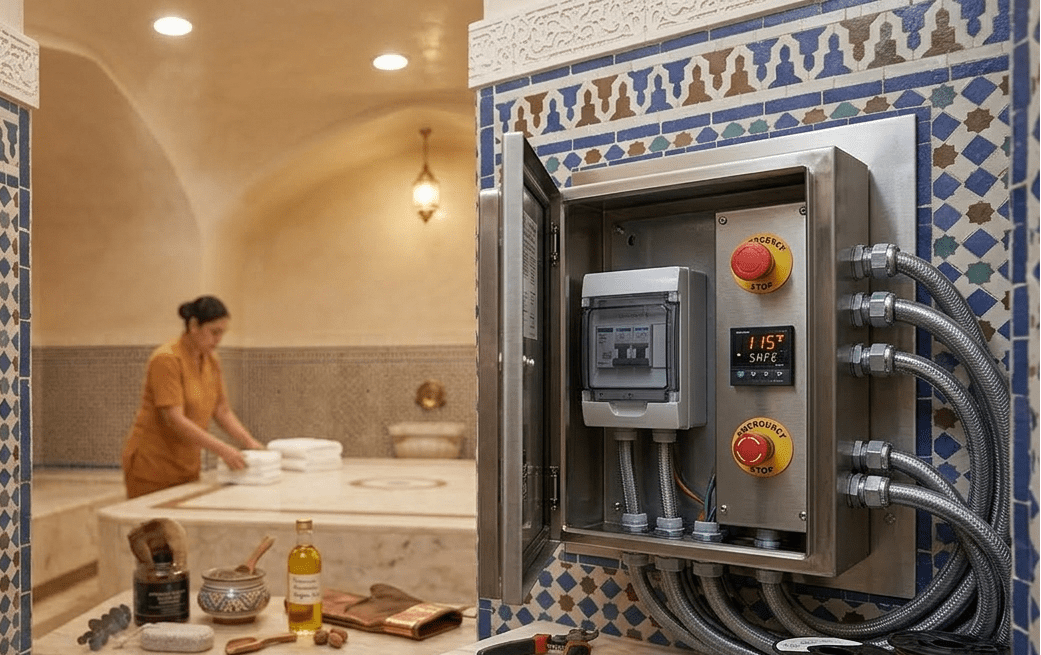
Electrical Requirements for Moroccan Steam Rooms in the UAE
The UAE is home to some of the world’s most ambitious moroccan steam room installations — from bespoke multi-room hammam suites within Palm Jumeirah villas to full-scale hammam spa complexes inside five-star hotels on Saadiyat Island and Yas Marina. As demand for authentic moroccan steam rooms across the Emirates continues to grow in 2026, so too does the complexity of ensuring that these installations meet the UAE’s specific electrical safety standards.
Electrical work in moroccan steam rooms is among the most technically demanding in any building type. The combination of 100% relative humidity, elevated temperatures between 45°C and 55°C, direct water contact on every surface, and high-power steam generator circuits creates an environment where substandard electrical installation carries life-threatening risk. In the UAE, this is compounded by a regulatory landscape that differs emirate by emirate — DEWA in Dubai, ADDC and AADC in Abu Dhabi, SEWA in Sharjah, and separate authorities in Ajman, Ras Al Khaimah, Fujairah, and Umm Al Quwain.
This is the complete 2026 guide to electrical requirements for moroccan steam rooms across the UAE. It covers the regulatory framework emirate by emirate, the IEC standards that govern all UAE electrical work, IP ratings and zone classifications, ELCB protection requirements, cable specifications for the UAE’s extreme climate, steam generator supply sizing, lighting requirements, underfloor heating, and the permit and inspection process for each major authority. Whether you are an MEP consultant, a licensed electrical contractor, a hammam builder, or a property owner commissioning a moroccan steam room in the UAE — this guide is your definitive compliance reference.
Why Electrical Requirements in Moroccan Steam Rooms Are Uniquely Demanding
Standard bathroom electrical requirements are already significantly more stringent than those for dry rooms. Moroccan steam rooms take this to another level entirely, for three compounding reasons:
1. Continuous High-Temperature Steam Saturation
Unlike a shower room where steam is intermittent and brief, moroccan steam rooms maintain elevated temperature and humidity continuously during operation — typically 45 minutes to 2 hours per session, multiple times daily in a commercial setting. This sustained exposure degrades standard electrical components rapidly. Cable insulation softens, junction box seals fail, and light fittings rated only for bathroom use develop condensation ingress within months of installation.
2. Direct Water Contact Across All Surfaces
Every surface in a moroccan steam room — walls, ceiling, floor, benches — is regularly wetted by steam condensation, bucket washing, and direct water spray. This means that electrical fittings mounted anywhere in the room (including the ceiling) are subject to direct water contact, not merely humidity or splashing. The ingress protection requirements this creates are far higher than for a standard wet room or even a swimming pool surround.
3. High Ambient Temperature Effects on Electrical Components
Most standard electrical components are rated to a maximum ambient temperature of 35°C to 40°C. Inside an operating moroccan steam room, ambient temperatures regularly exceed 50°C. At these temperatures, standard cable insulation can soften and become sticky, PVC conduit can deform, and junction box seals can lose their elasticity. Every component specified for a moroccan steam room must be rated for the actual operating temperature range it will experience — not the temperatures of a standard domestic bathroom.
The UAE Electrical Regulatory Framework: Authority by Emirate
Unlike a single-authority jurisdiction such as the UK or a single national code like the US NEC, the UAE operates a federated system in which each emirate’s electricity and water authority sets and enforces its own electrical installation requirements. All emirate authorities base their regulations on IEC 60364 (the International Electrotechnical Commission’s Low Voltage Electrical Installations standard), but each adds local amendments, approval requirements, and enforcement procedures.
Dubai: DEWA (Dubai Electricity and Water Authority)
DEWA is the governing authority for all electrical and water installations in the Emirate of Dubai. For moroccan steam rooms, DEWA’s requirements are among the most comprehensively documented of any UAE authority:
- All electrical installation designs for wet areas including moroccan steam rooms must be prepared by a DEWA-registered consultant (Registered Consultant Firm) and submitted through the DEWA NOC (No Objection Certificate) portal
- All installation work must be carried out by a DEWA-registered electrical contractor holding a current Category approval appropriate to the project scale
- MEP drawings including electrical zone plans, panel schedules, and single-line diagrams must be approved by DEWA before any electrical work commences
- On completion, the contractor must submit a DEWA Electrical Wiring Completion Certificate (EWCC), accompanied by test results and inspection records, to obtain authority approval before the installation is energised
- DEWA inspectors will physically inspect the installation prior to final connection to the DEWA grid — any non-compliance identified at inspection must be remediated before approval is granted
- For commercial moroccan steam room facilities (hotel spas, standalone hammam centres, mall-based wellness facilities), a separate DHA (Dubai Health Authority) spa facility licence is also required — and the electrical installation must comply with DHA’s own technical standards in addition to DEWA’s requirements
Abu Dhabi: ADDC and AADC
Abu Dhabi Emirate is served by two electricity distribution companies: ADDC (Abu Dhabi Distribution Company) covering the city of Abu Dhabi and most urban areas, and AADC (Al Ain Distribution Company) covering Al Ain and its surrounding areas. Both companies apply the Abu Dhabi Distribution Code, which is based on IEC 60364 with Abu Dhabi-specific amendments:
- Electrical installation designs must be submitted through the Abu Dhabi Municipality (ADM) planning portal and reviewed by ADDC or AADC as appropriate
- Registered Engineering Consultancies (RECs) with active ADDC/AADC approval must prepare the electrical design for any commercial moroccan steam room project
- The Abu Dhabi Distribution Code places particular emphasis on protection against overheating and fire — relevant for moroccan steam rooms given the elevated ambient temperatures involved
- Abu Dhabi’s Estidama (Pearl Rating System) sustainability requirements may apply to large hospitality and residential developments — MEP engineers should confirm whether Estidama credits relevant to electrical efficiency in wet areas apply to the project
- Commercial spa facilities in Abu Dhabi require a Department of Health (DoH) licence, which carries its own technical and compliance requirements for electrical and mechanical installations
Sharjah: SEWA (Sharjah Electricity and Water Authority)
SEWA governs electrical installations in the Emirate of Sharjah. For moroccan steam rooms, SEWA applies IEC 60364 standards with Sharjah-specific procedural requirements:
- SEWA-registered consultants and contractors must be appointed — their current registration must be confirmed before any design or installation work begins
- All electrical drawings must be submitted to SEWA’s Engineering Department for approval prior to commencement of work
- The SEWA Customer Service Portal (Khidmaty) is used for permit applications and inspection scheduling
- Commercial spa facilities in Sharjah require a Sharjah Commerce and Tourism Development Authority (SCTDA) commercial licence in addition to SEWA electrical compliance
Northern Emirates: Ajman, RAK, Fujairah, UAQ
The remaining northern emirates are served by their own electricity authorities — AED (Ajman), RAKIA (RAK), FCA (Fujairah), and UAQEWA (Umm Al Quwain). All apply IEC 60364 as the base standard. For moroccan steam room installations in these emirates, the procedural requirements are broadly similar to the framework described above, but with smaller authority structures that often allow for more direct engagement with inspectors and faster approval timelines. Always confirm the current registration and approval process directly with the relevant authority at the outset of the project.
Zone Classification for Moroccan Steam Rooms in the UAE
UAE electrical authorities apply IEC 60364-7-701 zone classification to wet areas. However, moroccan steam rooms present a unique classification challenge compared to standard bathrooms because the entire enclosure is a permanently wet, steam-saturated environment rather than a space with defined water zones around a fixed bath or shower.
UAE authorities and their approved consultants generally treat the entire interior of a moroccan steam room as a Zone 1 equivalent — the most stringent wet zone classification in IEC 60364-7-701 — for the purposes of determining IP ratings and permitted equipment types. Some DEWA-registered consultants apply an even more conservative interpretation, treating the full interior as a permanently wetted zone requiring IP65 or above for all equipment without exception.
ELCB and Earth Leakage Protection Requirements in UAE
Earth Leakage Circuit Breakers (ELCBs) — the UAE and IEC terminology for what the UK calls RCDs (Residual Current Devices) — are the critical safety device that prevents electrocution in the event of an earth fault in a wet environment. All UAE electricity authorities mandate 30mA ELCB protection for circuits serving moroccan steam rooms and other wet areas. Compliance with IEC 61008 or IEC 61009 is required for all ELCBs installed in UAE electrical systems.
DEWA ELCB Requirements for Moroccan Steam Rooms
- All final circuits supplying electrical equipment within or immediately adjacent to the moroccan steam room must be individually protected by a 30mA RCCB (Residual Current Circuit Breaker) complying with IEC 61008
- For circuits supplying variable-speed drive equipment (such as some ventilation fans and certain steam generator models), a Type F or Type B RCCB must be specified — standard Type A ELCBs may not adequately detect the waveform of earth fault currents produced by electronic drives
- DEWA requires the ELCB distribution board (DB) serving the moroccan steam room to be located outside the wet area in a dry or damp-rated enclosure, accessible for inspection and testing
- A dedicated sub-distribution board for the hammam/steam room electrical installation is considered best practice and is required for all commercial moroccan steam rooms under DEWA’s commercial project technical requirements
- ELCB test certificates must be included in the EWCC (Electrical Wiring Completion Certificate) package submitted to DEWA — all ELCBs must be tested and the trip time recorded (maximum 40ms at rated residual current)
Abu Dhabi (ADDC/AADC) ELCB Requirements
- Abu Dhabi Distribution Code Section 8 mandates 30mA residual current protection for all socket outlets and lighting circuits in wet areas including moroccan steam rooms
- ADDC additionally requires that all protective devices in the DB panel comply with the Abu Dhabi Approved Products List (APL) — only products from manufacturers on the APL are accepted. Contractors should verify product listing status before purchase.
- For projects subject to Abu Dhabi’s Estidama requirements, additional energy efficiency considerations may apply to the DB panel specification
SEWA ELCB Requirements
- SEWA applies IEC 61008 as the governing standard for ELCB specification in wet areas
- 30mA protection is mandatory for all circuits in Zone 1 and Zone 2 locations including moroccan steam rooms
- SEWA requires test records for all ELCBs to be included in the completion documentation submitted at the end of the project
Common ELCB Specification for UAE Moroccan Steam Rooms
Regardless of which UAE authority has jurisdiction, the following specification represents best practice for ELCB protection in moroccan steam rooms across the UAE:
- Type: RCCB to IEC 61008, or RCBO (combined overcurrent and residual current) to IEC 61009
- Sensitivity: 30mA rated residual current
- Type designation: Type A for standard circuits; Type F or Type B for circuits with electronic speed control or inverter loads
- Rated voltage: 230V/240V single-phase for residential; 400V three-phase for commercial steam generator circuits
- Breaking capacity: appropriate to the prospective fault current at the point of installation — confirm with MEP engineer
- Manufacturer approval: must appear on the relevant authority’s approved products list (DEWA, ADDC, or SEWA as applicable.
Cable Specifications for UAE Moroccan Steam Rooms
Cable selection for moroccan steam rooms in the UAE must address three overlapping requirements: the wet-location demands of a steam environment, the elevated ambient temperatures specific to UAE moroccan steam rooms, and the general UAE electrical authority requirements for wiring materials. Standard PVC-insulated cables (used in most UAE domestic wiring) are not appropriate for direct installation in a moroccan steam room environment.
Approved Cable Types for UAE Moroccan Steam Rooms
- XLPE (Cross-Linked Polyethylene) insulated cables to IEC 60502: the preferred general-purpose cable for all wiring within or passing through the moroccan steam room structure. XLPE insulation is rated to 90°C conductor operating temperature (versus 70°C for PVC), providing the safety margin required in a high-temperature steam environment. In the UAE, specify XLPE cables complying with IEC 60502-1 (low and medium voltage power cables) and confirm the cable is listed on the relevant authority’s approved materials list.
- LSZH (Low Smoke Zero Halogen) sheathed cables: required for all commercial moroccan steam room installations in Dubai and Abu Dhabi, where fire safety regulations mandate low-smoke, halogen-free cable throughout public and commercial buildings. LSZH cables comply with IEC 60332 and IEC 60754 fire performance standards.
- Heat-resistant flexible cables to IEC 60245: for connections to steam generator heating elements, final connections to high-temperature equipment, and any flexible wiring within the steam room. In the UAE, use HRFR (Heat Resistant Flame Retardant) grade flexible cable rated to a minimum of 180°C — specify cables complying with IEC 60245-4 (rubber-insulated, 300/500V) or IEC 60245-8 (heat-resistant braided, 180°C rating).
- Mineral Insulated Cable (MICC / PYRO) to IEC 60702: the gold standard for critical circuits in UAE moroccan steam rooms, particularly for commercial installations where circuit continuity under fire conditions is required. Mineral insulated cables are rated to 250°C continuous operating temperature, are completely immune to moisture ingress, and have an indefinite service life when correctly terminated. Cost is significantly higher than XLPE, but for steam generator supply circuits and emergency lighting in commercial hammam spas, MICC is often the most appropriate specification.
Cable Specifications for UAE Moroccan Steam Rooms
Cable selection for moroccan steam rooms in the UAE must address three overlapping requirements: the wet-location demands of a steam environment, the elevated ambient temperatures specific to UAE moroccan steam rooms, and the general UAE electrical authority requirements for wiring materials. Standard PVC-insulated cables (used in most UAE domestic wiring) are not appropriate for direct installation in a moroccan steam room environment.
Approved Cable Types for UAE Moroccan Steam Rooms
- XLPE (Cross-Linked Polyethylene) insulated cables to IEC 60502: the preferred general-purpose cable for all wiring within or passing through the moroccan steam room structure. XLPE insulation is rated to 90°C conductor operating temperature (versus 70°C for PVC), providing the safety margin required in a high-temperature steam environment. In the UAE, specify XLPE cables complying with IEC 60502-1 (low and medium voltage power cables) and confirm the cable is listed on the relevant authority’s approved materials list.
- LSZH (Low Smoke Zero Halogen) sheathed cables: required for all commercial moroccan steam room installations in Dubai and Abu Dhabi, where fire safety regulations mandate low-smoke, halogen-free cable throughout public and commercial buildings. LSZH cables comply with IEC 60332 and IEC 60754 fire performance standards.
- Heat-resistant flexible cables to IEC 60245: for connections to steam generator heating elements, final connections to high-temperature equipment, and any flexible wiring within the steam room. In the UAE, use HRFR (Heat Resistant Flame Retardant) grade flexible cable rated to a minimum of 180°C — specify cables complying with IEC 60245-4 (rubber-insulated, 300/500V) or IEC 60245-8 (heat-resistant braided, 180°C rating).
- Mineral Insulated Cable (MICC / PYRO) to IEC 60702: the gold standard for critical circuits in UAE moroccan steam rooms, particularly for commercial installations where circuit continuity under fire conditions is required. Mineral insulated cables are rated to 250°C continuous operating temperature, are completely immune to moisture ingress, and have an indefinite service life when correctly terminated. Cost is significantly higher than XLPE, but for steam generator supply circuits and emergency lighting in commercial hammam spas, MICC is often the most appropriate specification.
Do I need DEWA approval for the electrical installation in my moroccan steam room in Dubai?
Yes, without exception. All electrical installation work in Dubai — including in moroccan steam rooms and other wet areas within private villas and commercial properties — requires DEWA approval. The design must be prepared by a DEWA-registered electrical consultant and the installation carried out by a DEWA-registered electrical contractor. On completion, a DEWA Electrical Wiring Completion Certificate (EWCC) must be submitted and a DEWA inspection passed before the installation can be energised. Installing and using electrical equipment without DEWA approval is a regulatory offence and voids your property insurance.
What cable type should be used in a moroccan steam room electrical installation in the UAE?
Standard PVC-insulated cables are not suitable for moroccan steam room installations in the UAE. The correct specification is XLPE (Cross-Linked Polyethylene) insulated cables to IEC 60502, rated to 90°C conductor temperature. For commercial projects, LSZH (Low Smoke Zero Halogen) sheathed cables are also required under UAE fire safety regulations. For steam generator connections and other high-temperature flexible connections, IEC 60245 heat-resistant flexible cables rated to 180°C should be specified. All cables should be installed in IEC 61386-compliant conduit with IP65-rated fittings, and no cable joints should be made inside the steam room.
Do moroccan steam rooms in UAE hotels need civil defence approval for the electrical installation?
: Yes. Commercial moroccan steam room and hammam spa facilities in UAE hotels and resorts require UAE Civil Defence approval as part of the overall building and fit-out approval process. Civil defence requirements are particularly relevant to the emergency lighting specification, emergency stop circuit design, fire alarm integration, and means of escape from the steam room. In Dubai, approval is from Dubai Civil Defence (DCD); in Abu Dhabi, from Abu Dhabi Civil Defence (ADCD); in Sharjah, from Sharjah Civil Defence. Civil defence approval runs in parallel with the DEWA/ADDC/SEWA electrical approval process — both must be obtained before the installation is commissioned.